
BB fertilizer—or bulk-blended fertilizer—is produced through physical mixing rather than chemical reaction. Consequently, the quality of the raw materials directly determines the uniformity and stability of the final product, as well as the operational efficiency of the equipment. Huaqiang Heavy Industry emphasizes that to ensure a consistent output from a BB fertilizer production line, one must strictly control the physical properties, chemical compatibility, and impurity levels of the raw materials. The specific requirements are detailed below.
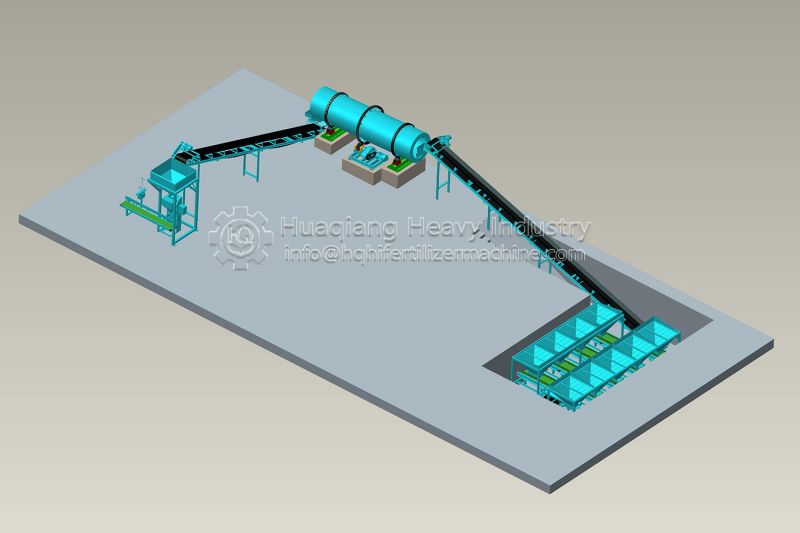
First, the particle size and specific gravity (density) of the raw materials must be well-matched; this is the most critical criterion for BB fertilizer ingredients. Ideally, particles should fall within the 2–4 mm range. The variance in particle size between different ingredients should be kept within ±0.5 mm, and the difference in specific gravity should not exceed 0.3 g/cm³. If there is too great a disparity in particle size or weight, the ingredients are prone to segregation (separation) during conveying, mixing, or bagging. This leads to inconsistent nutrient content within the same batch, rendering soil-test-based precision fertilization ineffective. Powdered raw materials are generally not recommended for direct use; if micronutrients are required, it is best to use granulated forms.
Second, moisture content and particle strength must be controlled. High moisture levels can cause materials to absorb water and clump together, leading to issues such as bridging or sticking to the walls of storage silos and feed inlets. Furthermore, damp materials may adhere to the interior of the BB fertilizer mixer, compromising weighing and metering accuracy. Ideally, moisture content should be kept below 2%; damp materials should be dried before being stored or introduced into the production process. Additionally, the particles must have sufficient hardness—ideally greater than 20 N per granule—to prevent them from breaking down into fine dust during lifting or mixing. An excess of fine particles exacerbates segregation and clumping, while also increasing dust pollution in the production facility.
Third, the raw materials must be chemically compatible to avoid unwanted reactions. Since BB fertilizer production relies solely on physical blending, any chemical reaction between ingredients can lead to moisture absorption, heat generation, or the loss of nutrient efficacy. For instance, urea should not be mixed directly with ammonium nitrate, and certain acidic phosphate fertilizers should not be combined with highly alkaline fertilizers. Before production, formulas must be verified in advance. It is strictly prohibited to introduce mutually reactive raw materials into the same production line, as this could lead to deterioration, caking, or nutrient loss in the finished product during storage.
Fourth, maintain strict control over impurities and harmful components. Foreign objects in raw materials—such as stones, plastics, or fibers—can damage components like bucket elevators, weighing scales, and mixers, potentially causing equipment jams. Incoming raw materials must undergo pre-screening to remove such debris. Furthermore, the levels of harmful substances, including chloride ions and heavy metals, must be carefully managed. The choice between potassium chloride and potassium sulfate should be based on specific crop requirements; for chloride-sensitive crops, low-chloride raw materials must be selected. This ensures that the fertilizer complies with national standards and prevents phytotoxicity.
An inspection protocol must be established for raw materials prior to storage, covering parameters such as particle size, moisture content, physical strength, and nutrient composition. Materials that fail to meet specifications should be screened, dried, or returned/exchanged. Raw materials must be stored in designated, segregated areas—protected from moisture and rain—to prevent spoilage during storage. Only by strictly enforcing raw material entry standards can a bulk-blend (BB) fertilizer production line operate reliably, ensuring uniform nutrient distribution in the final product and minimizing post-sale quality issues.
_800x600.jpg)
_800x600.jpg)
_800x600.jpg)
_800x600.jpg)