
A bio-organic fertilizer production line consists of a complete set of equipment designed to transform waste materials—such as livestock and poultry manure, crop straw, and agricultural organic residues—into live-microbe organic fertilizer through a harmless decomposition process. The process involves a series of interconnected stages, primarily comprising seven key steps: raw material pretreatment, high-temperature aerobic fermentation, crushing and ingredient mixing, granulation, drying and cooling, microbial coating, and final packaging. It serves as a core solution for the resource utilization of organic solid waste.
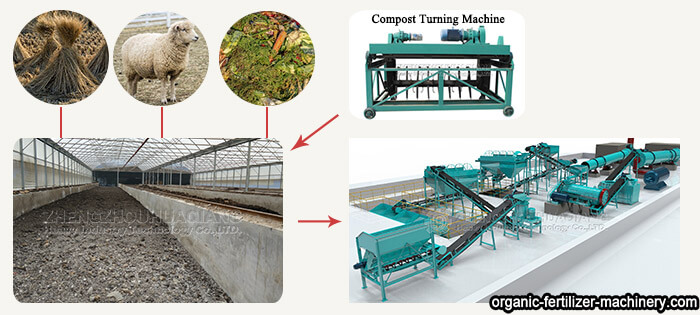
Raw material pretreatment forms the foundation of production. Before processing, materials are sorted to remove impurities like stones and plastics; rigid materials such as straw are crushed, while high-moisture manure undergoes dewatering. Simultaneously, the carbon-to-nitrogen (C/N) ratio and moisture content are adjusted to create an optimal environment for microbial fermentation, ensuring consistent and uniform fermentation in subsequent stages.
The decomposed material is then sent to the crushing and screening section to break up clumps and remove large, undecomposed residues. Next, nutritional additives—such as nitrogen, phosphorus, and potassium—are incorporated according to the formula and thoroughly mixed to produce a nutrient-balanced organic fertilizer powder.
The mixed powder is fed into a new type organic fertilizer granulator to be formed into granules. As the newly formed granules have high moisture content, they undergo low-temperature drying at 60–70°C. Since the dried granules are hot, they must be air-cooled to prevent heat damage to the live microbes. After cooling, the granules are screened again; substandard fragments are returned for re-granulation, while qualified granules proceed to the coating stage. Coating the granules with the microbial agent is a critical step in ensuring the product meets its viable microbe count standards; this process must be carried out only after the granules have fully cooled to ambient temperature. Inside the coating machine, the composite microbial agent and a protective additive are evenly sprayed onto the granule surfaces, alongside an anti-caking agent that safeguards the microbial population and enhances fertilizer stability. Continuous rotation of the drum ensures the microbial agent and additives adhere firmly to the granules, creating a complete, biologically active coating. This layer effectively blocks air and moisture, preventing microbial inactivation and fertilizer caking, thereby significantly extending the product's shelf life. Adding the microbial agent prior to the drying stage would result in high temperatures killing the beneficial microorganisms, causing the product to fall short of viable microbe requirements.
Once coated, the compliant granules are conveyed to an automated packaging station for quantitative filling, sealing, and coding before being placed in storage. The entire production line features a high degree of automation and an environmentally friendly, pollution-free process. It not only achieves the harmless treatment and resource recovery of agricultural waste but also produces high-quality bio-organic fertilizer capable of improving soil structure, revitalizing soil fertility, and promoting robust root and seedling growth—fully aligning with the development goals of green, ecological agriculture.
_800x600.jpg)
_800x600.jpg)
_800x600.jpg)
_800x600.jpg)