
When planning fertilizer projects, many international trade clients often confuse organic fertilizer production lines with bio-organic fertilizer production lines. While the initial stages of both lines may appear similar, there are significant differences in product positioning, process control, equipment configuration, and finished product testing requirements—factors that directly determine product quality and market suitability. Huaqiang Heavy Industry specializes in organic fertilizer production lines and offers one-stop services, customizing complete production solutions tailored to overseas markets.
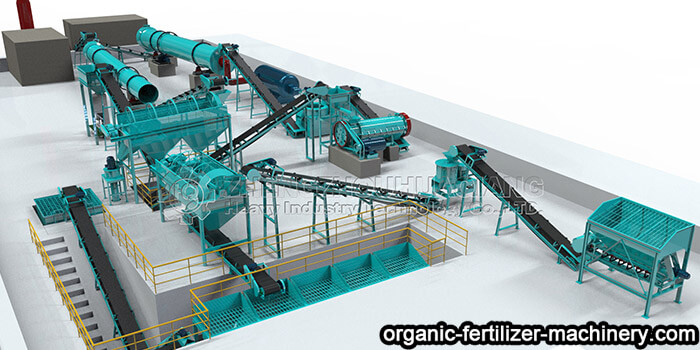
Both production lines can utilize the same raw materials—such as livestock manure, crop stalks, and spent mushroom substrate—and share fundamental processing stages: raw material pre-treatment, aerobic composting/maturation, crushing, granulation, screening, and packaging. The primary goal of a standard organic fertilizer line is to achieve material maturation and harmlessness (sanitization). High-temperature composting is relied upon to eliminate insect eggs and harmful pathogens; consequently, temperature constraints during drying are relatively relaxed, production control is less complex, and equipment investment costs are lower. Finished products are evaluated primarily on metrics such as organic carbon, heavy metal content, and pathogen levels; they are predominantly used for soil improvement in field crops to increase soil organic matter content.
The core distinction of a bio-organic fertilizer production line is the addition of a functional microbial inoculation stage. The activity of beneficial live bacteria must be preserved throughout the entire production process, necessitating stricter process control standards. Following material maturation, high-temperature drying is prohibited; instead, low-temperature drying methods are employed to prevent heat from killing the beneficial microorganisms. Functional microbial agents must be precisely introduced during the late granulation or cooling stages, requiring supporting constant-temperature storage systems for the agents and stable control of workshop temperature and humidity. In addition to organic matter content, finished products must specify the microbial strain and viable bacterial count, and undergo testing to monitor the decline of viable bacteria over the storage period.
The market positioning and project investment requirements differ for the two types of products. Standard organic fertilizer entails lower production costs and is primarily applied to field crops. Bio-organic fertilizer is frequently used for fruits, vegetables, and high-value cash crops, as it helps alleviate soil compaction and mitigates issues associated with continuous cropping. The procurement of microbial agents and the inclusion of temperature-control equipment drive up construction and operational costs; however, the resulting products offer higher added value, despite the longer lead times required for initial testing and certification.
In summary, while organic fertilizer production lines focus primarily on material decomposition and safety (sanitization), bio-organic fertilizer lines must balance decomposition efficiency with the preservation of viable microorganisms. Huaqiang Heavy Industry offers customized, complete organic fertilizer production lines tailored to specific target markets and production capacities. We provide a comprehensive, one-stop solution—covering everything from facility planning and equipment manufacturing to installation and commissioning—to ensure the stable production of fertilizers that meet the standards of overseas markets.
_800x600.jpg)
_800x600.jpg)
_800x600.jpg)
_800x600.jpg)