
A bio-organic fertilizer production line is a core set of equipment designed for the harmless treatment and resource utilization of organic waste, such as livestock manure, crop straw, and spent mushroom substrate. The line is configured based on a comprehensive process flow—covering fermentation, pre-treatment, granulation, drying, and finished product handling—with precisely integrated equipment that enables automated, large-scale production. A standardized, complete production line comprises seven major equipment systems, covering the entire process from raw material handling to final packaging.
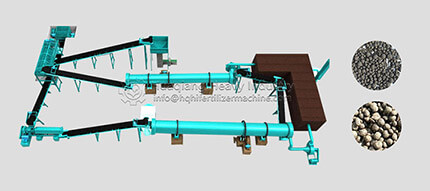
First is the fermentation and turning system, which is crucial for the decomposition and quality enhancement of the organic fertilizer. The core equipment is a trough-type compost turner, complemented by raw material conveyors, oxygen supply equipment, and biological deodorization units. It is primarily used to turn compost materials, ensure uniform oxygen supply and heat dissipation, accelerate microbial fermentation and decomposition, eliminate odors, and kill harmful pathogens. This system is key to the harmless treatment of raw materials while preserving organic matter content and biological activity.
Next is the raw material pre-treatment system, consisting of a solid-liquid separator, a crusher, and a screening machine. The solid-liquid separator adjusts the moisture content of materials like livestock manure to meet fermentation standards. The crusher breaks down fermented lumps and removes hard impurities. The screening machine separates qualified fine powder from coarse material, re-crushing any oversized particles to ensure uniform material fineness.
Then comes the batching and mixing system, composed of an automatic batching system and a double-shaft paddle mixer. The automatic batching system precisely proportions fermented materials, biological inoculants, and auxiliary additives. The mixer thoroughly blends these materials, ensuring the even distribution of biological strains and resulting in balanced nutrients and stable fertilizer performance—laying the groundwork for subsequent granulation.
The core shaping equipment is the granulation system; mainstream options include new-type organic fertilizer granulators, disc granulators, and spheronizers (rounding machines). The material is processed into uniform granules by a granulator, and a spheronizer refines their shape, resulting in round, plump granules with optimal hardness; this minimizes dust generation during application and enhances fertilizer utilization efficiency.
The downstream processing line features a drying and cooling system comprising a drum dryer, a cooler, and a hot-blast stove. The low-temperature drying unit ensures precise temperature control—preventing high-heat damage to the activity of biological strains while effectively reducing moisture content—while the cooler rapidly lowers the temperature to set the granule structure, preventing clumping and ensuring storage stability. Finally, the process concludes with screening, coating, and packaging systems: a grading screen separates compliant granules, a coating machine applies an anti-caking layer, and a fully automated packaging unit handles weighing, sealing, and bundling for standardized warehousing.
This equipment suite features a well-balanced configuration and a high level of automation, making it suitable for production lines of varying capacities. Combining environmental sustainability with high efficiency, it serves as core equipment for the resource utilization of organic waste and ecological agriculture.
_800x600.jpg)
_800x600.jpg)
_800x600.jpg)
_800x600.jpg)