
Amid the current transformation and upgrading of the agricultural inputs industry, lightweight and low-cost production models have become the preferred choice for micro and small enterprises. As a mainstream category of blended fertilizers, BB fertilizer—characterized by its simple processing and high flexibility—has become a popular investment target for many small agricultural input companies and planting cooperatives. When considering factors such as investment, operations, and market dynamics, BB fertilizer production lines are highly suitable for small enterprises, making them an excellent choice for small-scale operators looking to launch a business or expand production.
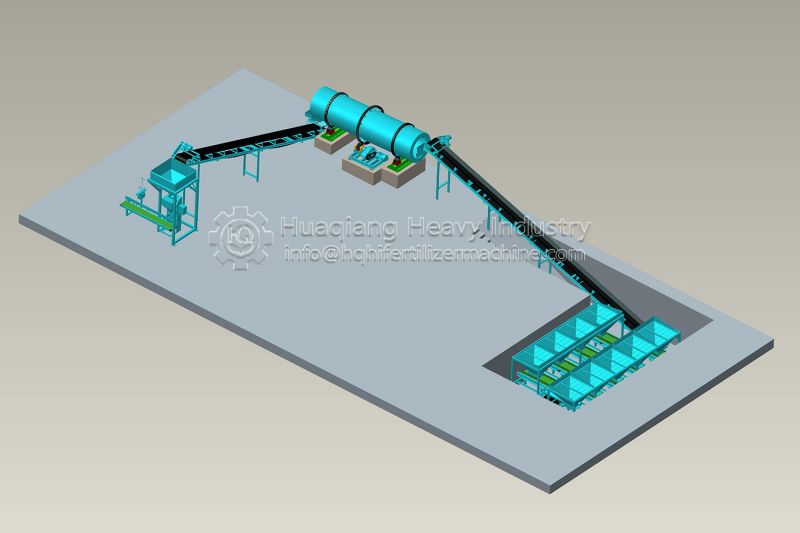
Low investment and a low barrier to entry are the core advantages making it suitable for small enterprises. Traditional compound fertilizer production lines involve complex processes like granulation, drying, and cooling, requiring expensive equipment, specialized facilities, and long lead times before production begins. In contrast, BB fertilizer production lines require only a few physical steps—batching, mixing, and packaging—and do not need large-scale equipment like boilers or drying kilns; the equipment investment is merely one-third to one-half that of a traditional compound fertilizer line. Furthermore, the equipment has a small footprint and minimal facility requirements, with installation and commissioning completed in just 15 to 30 days, significantly reducing financial pressure and the cost of trial and error for small enterprises. Additionally, the production line boasts extremely low energy consumption—using less than 1.5 kWh of electricity per ton of fertilizer—making daily operating costs very affordable.
Production flexibility and alignment with local markets represent another key highlight. Small agricultural input enterprises typically serve concentrated geographic areas where crop types and soil fertility vary widely, leading to diverse fertilizer formula requirements. BB fertilizer production lines allow for the real-time adjustment of N-P-K ratios to quickly meet the fertilization needs of various crops, such as fruits, vegetables, grains, and oilseeds. They support small-batch, multi-variety production, perfectly matching the regionalized and customized nature of the agricultural inputs market while effectively avoiding the inventory backlog issues often associated with the large-scale production of major enterprises.
Of course, small enterprises entering this sector must also navigate potential drawbacks. The technical barrier for BB fertilizer is low, leading to fierce market competition characterized by product homogeneity; moreover, the product demands high raw material quality and uniform mixing, meaning that crude production methods can easily damage a company's reputation. At the same time, the capacity of small-scale production lines is limited, making them suitable for deep cultivation of local markets but difficult to scale for broad market expansion.
In summary, the BB fertilizer production line is well-suited for small-scale agricultural supply enterprises that focus on deep local market penetration, operate with limited capital, and utilize an on-demand production model. By strictly controlling raw material quality, optimizing formulas, and cultivating regional distribution channels, these businesses can achieve stable profitability with minimal investment—making this an excellent sector for micro and small enterprises to enter the fertilizer manufacturing industry.
_800x600.jpg)
_800x600.jpg)
_800x600.jpg)
_800x600.jpg)