
BB fertilizer, also known as bulk-blended fertilizer, is widely used in agriculture due to its flexible formulations, targeted nutrient delivery, and low production costs. While production relies primarily on simple physical blending, various quality issues frequently arise during actual operations, directly affecting fertilizer efficacy and product compliance rates. Based on practical production experience, common problems generally fall into five categories: proportioning, mixing, material characteristics, equipment, and raw material compatibility.
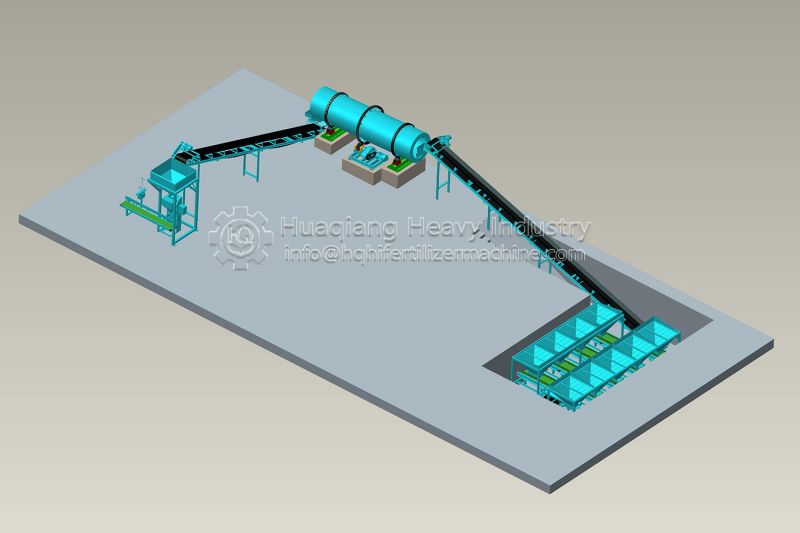
Inaccurate ingredient proportioning is a primary issue. In some BB fertilizer production lines, aging or poorly calibrated weighing equipment—or significant errors in manual feeding—causes the ratios of nutrients like nitrogen, phosphorus, and potassium to deviate from standard formulas. Additionally, some enterprises cut costs by arbitrarily reducing the input of expensive raw materials, resulting in nutrient deficiencies. This issue is difficult to detect visually but leads to substandard nutrient levels and crop nutritional imbalances, severely impacting agricultural yields.
Poor mixing uniformity and particle segregation (layering) are common pain points. Significant differences in particle size and density among raw materials cause fine particles to separate from larger ones during mixing, conveying, and discharging. Furthermore, improper discharge methods (such as end-screw discharge) or incorrect mixing times can disrupt the blend structure, leading to uneven nutrient distribution between the top and bottom layers of the finished product; this results in localized nutrient excesses or deficiencies and uneven soil fertility after application.
Issues such as moisture absorption, caking, and chemical incompatibility occur frequently. Nitrogen fertilizers like urea must not be mixed with calcium-containing oxides, and combining high-salt raw materials can trigger chemical reactions that cause moisture absorption and hardening (caking). Improper blending of ammonium-based nitrogen fertilizers can lead to ammonia volatilization, while water-soluble phosphorus may degrade; these issues not only reduce fertilizer utilization efficiency but also cause caking and the generation of excessive fines when cakes break apart, thereby compromising the product's physical appearance.
Equipment residue contamination and inadequate cleaning are also issues that cannot be overlooked. During formula changes on a BB fertilizer production line, sticky material residues tend to adhere to the inner walls of the mixing drum; if not thoroughly cleaned, these residues can mix with the new formula, leading to formulation errors, nutrient contamination, inconsistent product quality, and frequent quality control failures.
To address these issues, BB fertilizer production requires the periodic calibration of weighing equipment and the standardization of feeding procedures. Manufacturers should select raw materials with similar particle sizes and densities and optimize the mixing process by employing full-width discharge methods. Strict control over raw material compatibility and the use of sealed, moisture-proof packaging are essential. Additionally, equipment must be thoroughly cleaned of residues during product transitions to ensure consistent production quality at the source.
_800x600.jpg)
_800x600.jpg)
_800x600.jpg)
_800x600.jpg)