Leveraging their advantages of flexible formulation and strong adaptability, BB fertilizer production lines are widely utilized in modern agricultural production. The proper operation of these lines directly impacts product quality, production safety, and equipment longevity. To ensure the efficient and stable operation of the production line—while mitigating safety hazards and quality issues—the following key precautions have been compiled based on practical production experience.
Raw material control serves as the foundation and must strictly adhere to regulatory requirements. The use of powdered raw materials is strictly prohibited; all raw materials must be in granular form, sized between 2–4 mm. These materials must be screened to remove impurities such as stones and metal fragments, ensuring uniform particle size to prevent segregation and stratification. Additionally, raw material compatibility must be verified to avoid mixing incompatible substances—such as urea with ammonium nitrate, or diammonium phosphate with superphosphate—which could lead to caking or adverse chemical reactions. Raw materials must be stored in designated, categorized zones, with adequate measures taken to prevent moisture ingress and dust accumulation, thereby avoiding cross-contamination. In particular, ammonium nitrate-based materials must be kept strictly separate from organic substances.
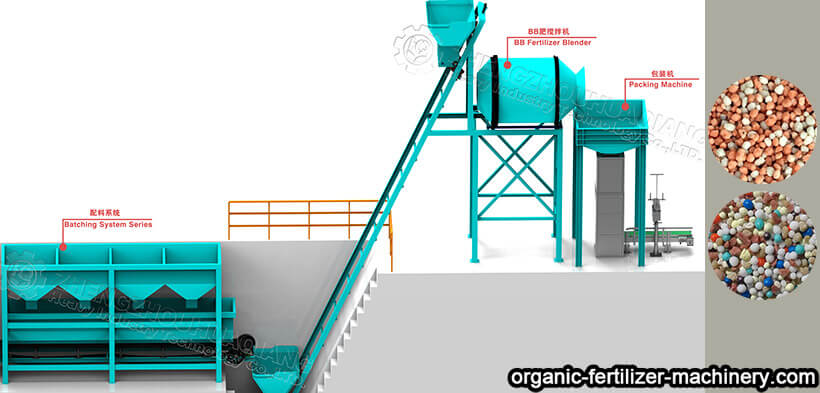
Operational procedures for the BB fertilizer production line must be standardized, with critical production stages carefully controlled. During the batching process, raw materials must be weighed precisely according to the specific formula, utilizing dedicated weighing scales to ensure that nutrient ratios meet established standards. The mixing phase should be controlled to last between 3 and 8 minutes, aiming for a coefficient of variation in mixing uniformity of ≤10%; this prevents particle breakage caused by excessive mixing duration while avoiding uneven mixing resulting from insufficient time. When discharging the finished product, the machine must first be shut down and the power supply disconnected; the discharge gate should only be opened once the mixing paddles have come to a complete standstill. The material should be discharged at a steady rate, and the finished product must be properly labeled to minimize material residue and waste.
Equipment maintenance is paramount and must not be overlooked, as it ensures long-term, stable operation. Prior to starting the machine each day, operators must inspect components such as the mixing paddles, transmission system, and inlet/outlet gates to confirm that there are no loose parts, no mechanical jamming, and that all seals remain intact. Equipment must be regularly cleaned to remove residual materials, lubrication oil levels must be replenished, and any worn components must be replaced in a timely manner. Furthermore, dedicated screening and mixing equipment must be utilized; sharing this equipment with compound fertilizer granulation lines is strictly prohibited to prevent cross-contamination. An on-site laboratory must be established within the facility to conduct periodic quality testing of both raw materials and finished products, ensuring full compliance with the GB/T 21633-2023 standard.
Safety precautions must be fully implemented to establish a robust defense against workplace hazards. Operators are required to wear appropriate personal protective equipment (PPE), such as safety helmets and dust masks; any unauthorized or non-compliant operational practices are strictly prohibited. Production sites must be equipped with fire-fighting apparatus and safety warning signage; furthermore, explosion-proof dust removal equipment must be deployed in areas prone to dust accumulation. Comprehensive emergency response plans should be established, and safety training and drills conducted on a regular basis. Potential hazards—such as material leaks and equipment malfunctions—must be promptly identified and rectified to prevent safety incidents, including fires and explosions.
In summary, the operation of a BB fertilizer production line requires the integration of raw material control, standardized operational procedures, equipment maintenance, and safety precautions throughout the entire process. By strictly adhering to industry standards and operational protocols, it is possible to ensure consistent product quality while achieving both safe production and efficient operations.
_800x600.jpg)
_800x600.jpg)