Answer: The production of bio-organic fertilizer primarily consists of five core steps. This streamlined, standardized process is crucial for ensuring the fertilizer's nutrient content and the viability of its beneficial microbes.
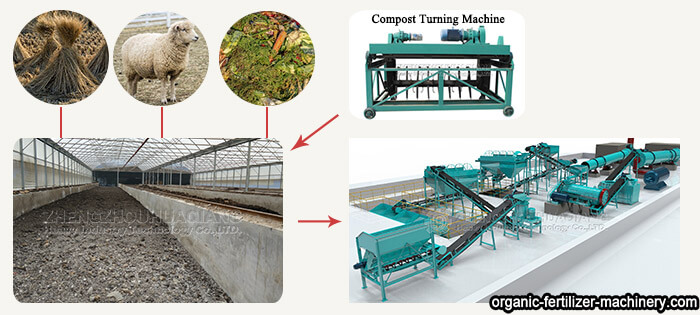
Step 1: Raw material proportioning. Organic wastes—such as livestock manure, crop straw, soybean meal, and spent mushroom substrate—are selected and mixed according to an optimal carbon-to-nitrogen (C/N) ratio. Impurities are removed and moisture levels adjusted to create an ideal environment for microbial proliferation during the subsequent fermentation stage.
Step 2: High-temperature composting and fermentation. This is the core stage. Specialized microbial inoculants are added to the prepared mixture. Through turning and aeration, the material undergoes sustained high-temperature fermentation, which effectively eliminates insect eggs, pathogens, and weed seeds. Thorough decomposition prevents issues such as root burn or secondary fermentation during later use.
Step 3: Crushing and screening. After the fermented material cools naturally, a crusher breaks down any clumps. Screening equipment then removes impurities and separates uniform granules, ensuring consistent particle size.
Step 4: Inoculation with functional microbes. This is a critical step for bio-fertilizers. Functional beneficial microbes—such as nitrogen-fixing, phosphorus-solubilizing, and potassium-solubilizing bacteria—are added and evenly mixed at ambient temperature. Since high temperatures would kill these live microbes, the process is conducted at lower temperatures to preserve their viability.
Step 5: Granulation and packaging. The mixture is granulated, dried, and cooled. Finally, the product undergoes testing to ensure nutrient levels and viable microbe counts meet standards before being weighed, packaged, and placed in storage, completing the production process.
_800x600.jpg)
_800x600.jpg)