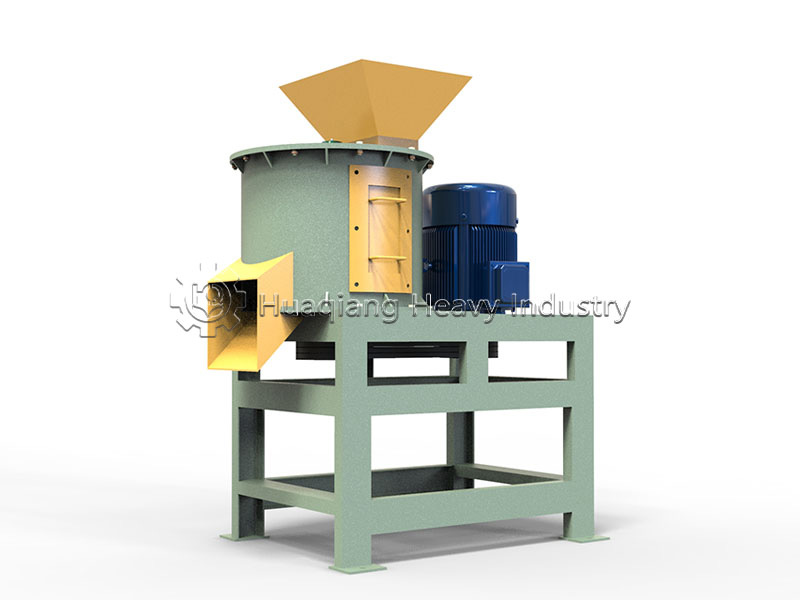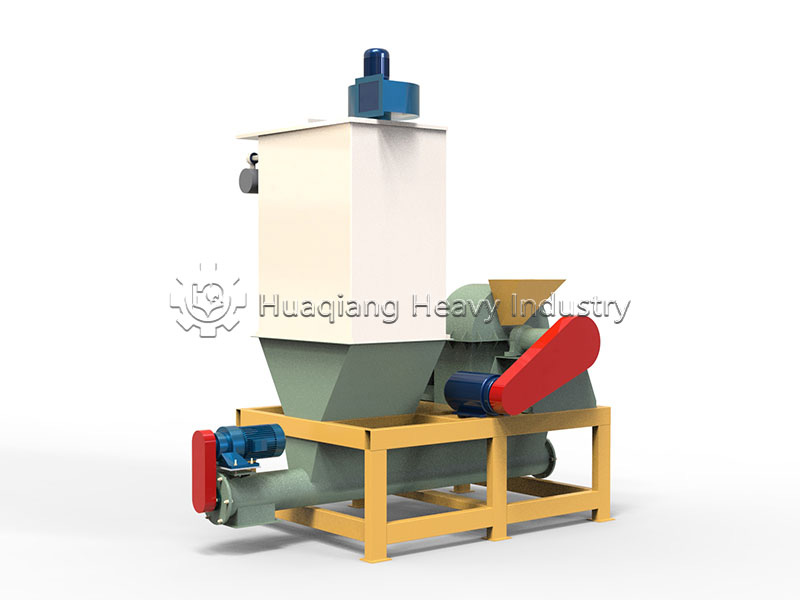
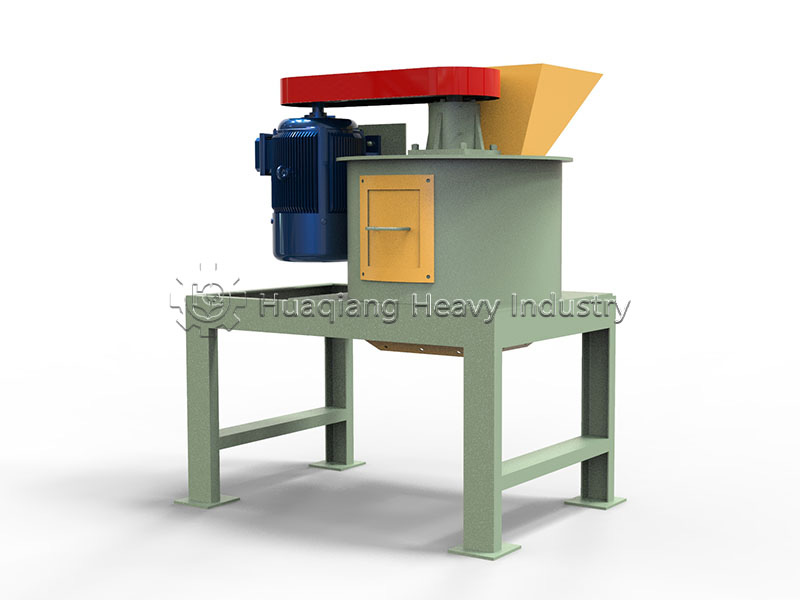
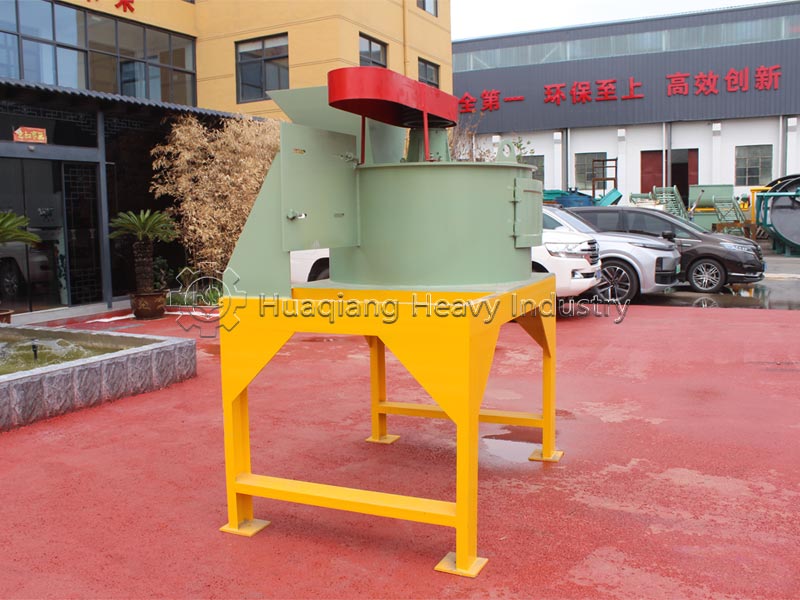

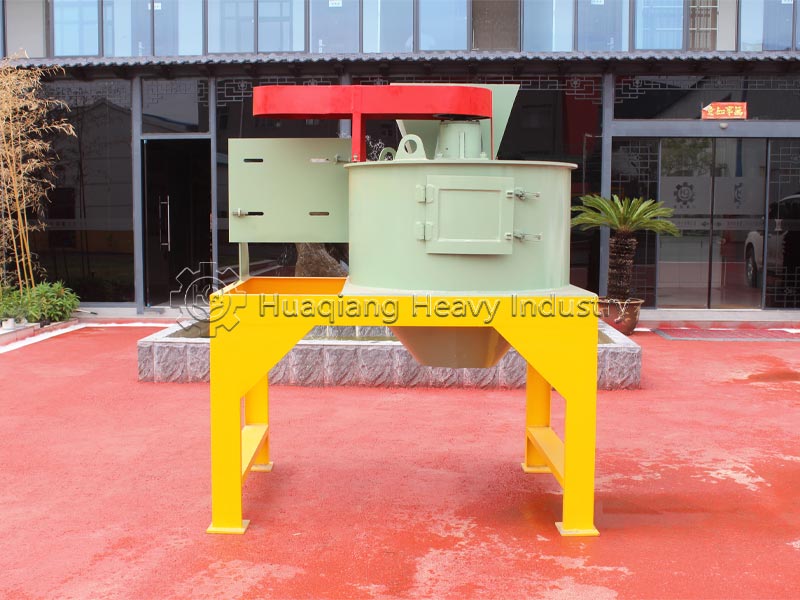
The chain crusher is a type of impact crushing equipment; its core working component is a rotor fitted with steel link chains. One end of each chain is connected to the rotor, while the other end is equipped with a chain head made of wear-resistant steel. Simply put, it does not crush material through compression or grinding; instead, it uses high-speed swinging chains to "whip" the material, breaking it apart and pulverizing it.
When the motor is powered on, it drives the internal rotor to spin at high speed, causing the chains to extend outward and become taut due to centrifugal force. Clumped fertilizer, coal slag, or clay lumps enter the crushing chamber through the top inlet.
The rapidly swinging chain hammers repeatedly strike the raw material lumps; the materials collide with one another, while the chains shear and grind the hard masses. Fine particles pass through the gap at the bottom of the chamber and are discharged, whereas larger pieces remain inside to undergo continuous impact and crushing until they are reduced to the required size and fall through the discharge outlet.
The flexible cushioning mechanism of the chains is a key advantage; if hard impurities—such as stones or pieces of iron—accidentally enter the machine, the chains yield to absorb the shock rather than rigidly resisting the impact. Compared to hammer-style crushers, this design reduces the equipment failure rate by approximately 30%.
The fertilizer manufacturing industry is the primary sector for the application of chain crushers. Their superior performance in handling moist, caked materials offers advantages that many other crushing devices cannot match:
Crushing hardened lumps of organic fertilizer (such as chicken, sheep, or cattle manure) after fermentation;
Breaking up caked compound fertilizers and NPK granules that have hardened after cooling;
Processing large chunks of fermented material following the composting stage to facilitate subsequent screening;
Crushing raw materials such as soil, humus, fermented straw, and peat.
Beyond the fertilizer industry, this equipment is also capable of processing coal lumps, slag, gypsum, clay blocks, and caked chemical raw materials, making it suitable for small-scale crushing operations in the construction materials, chemical, and mining sectors.
Flexible chain impact mechanism withstands hard objects and prevents equipment jamming.
Moist, sticky fertilizers do not easily adhere to the chamber walls, making residue cleanup simple.
Produces uniform granules, with particle size adjustable via a variable frequency drive (VFD).
Simple structure with chain hammers as the only wear parts, ensuring low replacement costs.
Minimal vibration during operation, eliminating the need for complex vibration-dampening foundations.
Enclosed chamber design allows for the connection of dust collection systems, resulting in low dust pollution.
Select a model based on your production line capacity: choose a vertical model for small-scale workshops, while large processing plants should prioritize horizontal dual-rotor chain crushers.
For processing high-moisture livestock manure fertilizer, prioritize models featuring thickened, wear-resistant chains and rubber-lined crushing chambers.
If the budget allows, opt for a variable-frequency drive (VFD) motor; this enables precise control over particle size to suit various granulation processes.
Prioritize manufacturers that offer comprehensive after-sales support for the entire fertilizer production line. Huaqiang Heavy Industry provides one-stop technical support and a full suite of equipment—covering everything from composting/turning and crushing to granulation and screening. Overseas clients can view our case studies page to see examples of production line configurations.
Thanks to its unique impact-based crushing principle, excellent resistance to clogging, and flexible particle size adjustment capabilities, the chain crusher plays a vital role in material size reduction across various industries. A solid understanding of its operating principles, suitable applications, and maintenance requirements is essential for making informed decisions regarding equipment selection and usage. Should you have any questions about specific models or application scenarios, it is recommended to contact the equipment supplier directly for a tailored technical solution.
| Model | Input Particle(mm) | Output Particle(mm) | Power(kW) | Capcity(t/h) |
| LP500 | ≤60 | <Φ0.7 | 11 | 1-3 |
| LP600 | ≤60 | <Φ0.7 | 15 | 1-5 |
| LP800 | ≤60 | <Φ0.7 | 15 | 2-8 |