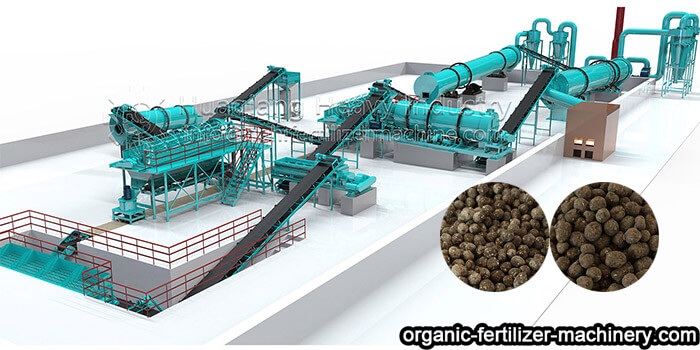
Bio-organic fertilizer production is a standardized and streamlined microbial fermentation processing system. It uses organic waste such as livestock and poultry manure, straw, kitchen residues, etc. as raw materials, and undergoes processes such as mature fermentation, refinement, granulation, drying and screening to produce finished products. The complete production process directly determines the number of viable bacteria, organic matter content and use effect of fertilizer. Standardized operation is the core to ensure that products meet standards and enhance market competitiveness. The following is a detailed explanation of the full set of standard production processes.
The first step is raw material pretreatment, which is the basic link of production. First, organic raw materials that are free of mildew and heavy metals are screened, and then used with auxiliary materials such as straw and sawdust to adjust the carbon-nitrogen ratio to solve the problems of excessive stickiness and poor air permeability of the raw materials. The raw materials are then crushed and screened to remove large impurities and hard lumps to ensure uniform thickness of the materials, laying a solid foundation for subsequent fermentation and granulation to avoid problems such as uneven fermentation and difficulty in molding in the later stage.
The second step is the core high-temperature fermentation process. Mix the well-proportioned materials evenly into the special biological strains, continuously turn them through a organic fertilizer compost turning machine to add oxygen, and control the fermentation temperature at 55-70°C. After 7-15 days of high-temperature fermentation, insect eggs, pathogens and weed seeds in the raw materials are completely killed, and the organic matter is degraded and matured at the same time. Ventilation, temperature and humidity must be strictly controlled in this process to avoid incomplete fermentation and secondary pollution, and ensure that the fertilizer is safe, harmless and up to standard in activity.
The third step is fine conditioning of materials. The fermented semi-finished materials need to be left to cool down and mature to stabilize the activity of microbial flora. Afterwards, it is crushed and screened again to refine the material particles. At the same time, the moisture content of the material is detected. The moisture content is adjusted to the granulation standard of 25%-30% by airing or drying. An appropriate amount of bonding auxiliary materials are added according to the needs to optimize the adhesion of the material and prepare for granulation and molding.
The fourth step is granulation molding and deep processing. The conditioned materials are fed into the new type organic fertilizer granulator and made into uniform particles. The shaped particles enter the drying and cooling equipment to gradually reduce the moisture, solidify the particle shape, and prevent the particles from loosening and powdering. Subsequently, the drum screening machine is used to screen out the qualified particles. The powder and unqualified particles can be reflowed for reproduction, effectively reducing the loss of raw materials.
Finally, the packaging and finished products are inspected and put into storage. The finished particles are tested for organic matter, viable bacterial count, moisture, nutrients and other indicators. After reaching the standards, they are automatically measured, sealed and packaged. The entire bio-organic fertilizer production process is interlocking. Relying on standardized bio-organic fertilizer production line operations and controlling each process, it can not only ensure stable fertilizer quality, but also effectively improve production efficiency and reduce production costs.
_800x600.jpg)
_800x600.jpg)
_800x600.jpg)