
In the actual operation of bio-organic fertilizer production lines, manufacturers often encounter issues such as low granulation rates, loose or easily broken granules, and excessive powder. These problems severely impact the product's appearance, packaging efficiency, and market competitiveness. In reality, granulation difficulties are rarely caused by a single equipment issue; rather, they usually stem from a combination of factors, including raw material conditions, process parameters, additive ratios, and improper equipment calibration. This article breaks down the core causes and offers practical, actionable solutions.
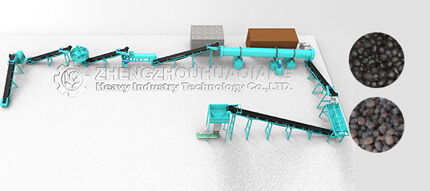
Improper raw material moisture content is the primary cause of granulation failure. Bio-organic fertilizer granulation has strict moisture requirements, with the standard moisture content needing to be controlled between 25% and 30%. If moisture is too high, the material becomes overly sticky, leading to machine clogging, roller adhesion, and clumping, which prevents the formation of uniform granules. Conversely, if moisture is too low, the material becomes dry and lacks adhesiveness; the powder fails to bind together, resulting in a sharp drop in the molding rate and producing granules that are loose and fragile. Many small-scale manufacturers fail to properly control the air-drying or heat-drying processes after fermentation, resulting in substandard moisture levels that directly compromise granulation results.
Substandard raw material fineness and maturity levels are another major factor. Materials that have not been sufficiently pulverized contain impurities and uneven particle sizes; this leads to uneven stress distribution during granulation, making it difficult for the material to bind and form properly. Furthermore, incomplete decomposition—specifically the presence of undegraded coarse fibers—disrupts the material's structural integrity. This not only hinders molding but also results in inconsistent granule sizes and excessive porosity, making the product prone to crumbling during storage. Additionally, over-fermented materials suffer from a loss of organic matter and reduced adhesiveness, which also leads to molding difficulties.
Improper additive ratios are also a key contributing factor. Pure bio-organic matter has limited natural adhesiveness. If the dosage of additives—such as binders or bentonite—is insufficient, the material lacks the cohesion needed to form stable granules. Conversely, excessive additives can result in granules that are too hard and have poor permeability, thereby compromising fertilizer quality. Many manufacturers rely solely on experience for mixing ratios without making fine adjustments based on the specific type of raw material, making granulation failures highly likely.
Finally, improper calibration of equipment parameters plays a role. Improper settings for granulator speed, roller pressure, or gap width, along with inconsistent feed rates, can lead to inadequate material compression, resulting in issues such as loose or malformed granules. Additionally, material buildup inside the equipment and component wear or aging can compromise granulation quality.
To resolve these issues, it is essential to precisely control material moisture content, thoroughly pulverize decomposed materials, scientifically adjust additive ratios, and properly calibrate equipment parameters. These measures improve the granulation rate at the source and ensure consistent product quality for the bio-organic fertilizer production line.
_800x600.jpg)
_800x600.jpg)
_800x600.jpg)
_800x600.jpg)