
The key to establishing a new blended fertilizer plant lies in selecting a production line that aligns with the plant's capacity, site constraints, and product positioning. Proper selection not only controls investment costs and minimizes wasted space but also ensures precise nutrient ratios and production stability. It prevents future issues such as insufficient capacity, uneven nutrient distribution, and frequent equipment breakdowns—serving as the foundation for a profitable operation.
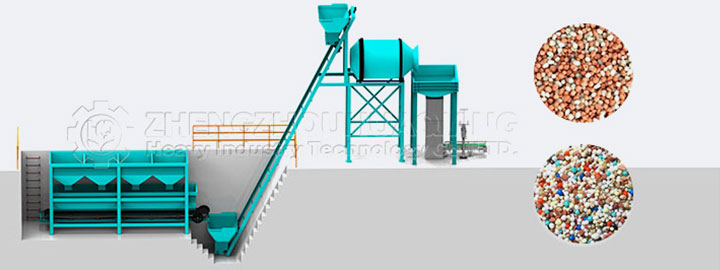
First, determine the production capacity based on market demand; this is the fundamental prerequisite for selection. Huaqiang Heavy Industry, a specialist in fertilizer equipment, offers a comprehensive range of BB fertilizer production lines tailored to various plant scales and requirements. Small-scale township blending stations and agricultural supply stores are best suited for simple, automated lines with an hourly output of 3–8 tons; these feature low investment costs, a small footprint, and ease of operation, making them ideal for small-batch, high-frequency production. Medium-sized county-level enterprises can opt for fully automated lines with an hourly output of 8–15 tons to meet regional supply needs, offering the best cost-performance ratio. Large-scale regional enterprises can choose Huaqiang Heavy Industry’s large-scale integrated systems with capacities exceeding 15 tons per hour; these are designed for mass production and contract manufacturing, ensuring stable operation and high output.
Second, carefully evaluate key performance parameters to ensure product quality compliance. The batching system is critical; Huaqiang Heavy Industry’s lines feature multi-bin automatic batching system that limits batching errors to within 0.5%, ensuring precise control over the ratios of nitrogen, phosphorus, potassium, and secondary/micro-nutrients. The specialized BB fertilizer mixer employs a multi-dimensional mixing process with a coefficient of variation for uniformity of less than 5%, effectively eliminating issues like nutrient stratification and uneven mixing. Additionally, the equipment comes standard with anti-stratification discharge and buffer storage structures, effectively preventing particle segregation during material conveying and bagging to ensure consistent quality across every batch.
Finally, align the equipment configuration with the facility's conditions. Small production lines require a footprint of approximately 100–200 m² and no complex infrastructure, making them suitable for new, compact plants; medium and large lines require a standardized facility of over 200 m² to accommodate the full automated workflow of feeding, batching, and packaging. Daily operations require only 2–3 personnel; the high level of automation effectively reduces labor costs.
Finally, selecting a reliable equipment manufacturer is crucial, as it directly determines the production line's operational efficiency and service life. It is advisable to prioritize professional manufacturers—such as Huaqiang Heavy Industry—that have deep expertise in the fertilizer equipment sector and a proven track record of successful plant installations. Their equipment is constructed from thickened, wear-resistant steel, offering corrosion resistance and low failure rates for stable, long-term, high-volume production. Furthermore, comprehensive after-sales maintenance and rapid spare parts supply systems eliminate concerns regarding post-installation operations. Users can select optional auxiliary equipment—such as specialized screening, dust removal, and automatic sealing systems—tailored to their specific production requirements. Through informed equipment selection, precise configuration, and reliance on dependable machinery and services, a BB fertilizer production line can operate with high efficiency and stability, enabling the facility to launch successfully and achieve long-term profitability.
_800x600.jpg)
_800x600.jpg)
_800x600.jpg)
_800x600.jpg)