The selection of equipment for a fertilizer production line directly determines production efficiency, product quality, and operating costs, making it a core aspect of the production process for fertilizer companies. Scientific selection requires basing it on the company's own production needs, considering practicality, adaptability, and economy, avoiding blindly pursuing high-end or low-priced options. This is crucial for achieving a dual improvement in capacity and efficiency. Below are specific selection points.
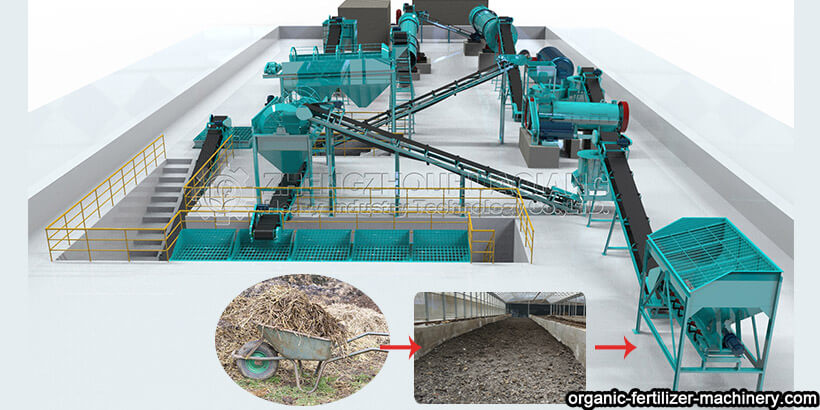
Based on production scale and capacity, accurately matching equipment specifications is the primary prerequisite for selection. Small production lines can choose equipment with simple structure, small footprint, and high cost-effectiveness, such as static batching machines, drum mixers, and semi-automatic packaging machines. Excessive automation is unnecessary, reducing initial investment costs. Medium-sized production lines require highly efficient, interconnected equipment, such as hammer mills, double axis paddle mixers, and though compost turning machines, to meet the needs of large-scale production. Large production lines should use fully automated equipment, paired with a PLC control system, to achieve full-process linkage of raw material processing, batching, granulation, and packaging, improving production efficiency. At the same time, it is necessary to avoid "oversized equipment for small tasks" or insufficient capacity, ensuring that the capacity of individual machines synergizes with the overall production line.
Choosing the right equipment model based on fertilizer type and processing technology is crucial for ensuring product quality. Different fertilizers have significantly different production processes. Organic fertilizers emphasize fermentation and crushing equipment, while bio-organic fertilizers require additional closed-loop inoculation equipment to prevent contamination by other microorganisms and inactivation of functional bacteria. Compound fertilizers require different granulation equipment depending on processes such as granulation or extrusion. Rotary drum granulators are suitable for large-scale production, while roller extrusion granulators are suitable for heat-sensitive raw materials. Furthermore, the characteristics of the raw materials must be carefully considered. High-moisture raw materials should be granulated using a stirring tooth granulator, while drier raw materials can be granulated using an extrusion granulator. Raw materials with high hardness require a roller crusher.
Balancing environmental compliance with long-term operational efficiency, the overall performance of the equipment must be considered. With increasingly stringent environmental requirements, closed-loop equipment with deodorization and dust removal systems should be prioritized to reduce exhaust gas and dust pollution and meet industry environmental standards. Meanwhile, the durability, energy consumption, and after-sales service of the equipment are also crucial. Prioritize equipment made of corrosion-resistant materials and manufactured with superior processes to reduce later maintenance costs; pay attention to equipment energy consumption indicators to achieve energy conservation and emission reduction; and choose fertilizer machine manufacturers with comprehensive after-sales service to ensure reliable equipment installation, commissioning, maintenance, and repair.
In summary, the selection of fertilizer production line equipment should abandon a "one-size-fits-all" approach. It should be based on production scale, product technology, and environmental protection and energy conservation, comprehensively considering equipment adaptability, economy, and after-sales service. Only through scientific selection and reasonable matching can an efficient, stable, and compliant production system be built, helping enterprises enhance their core competitiveness and achieve sustainable development.
_800x600.jpg)
_800x600.jpg)