Agglomeration in finished bio-organic fertilizer is a common quality problem during production, storage, and transportation. It not only affects the product's appearance, flowability, and ease of use, but can also lead to the inactivation of beneficial microorganisms and reduced fertilizer efficiency, causing losses to both producers and growers. Agglomeration is essentially the formation of "crystal bridges" and "liquid bridges" between fertilizer particles. Based on practical production experience and relevant technical points, this article analyzes the causes of agglomeration and provides practical solutions to help companies avoid this problem and improve product quality.
The core causes of finished product agglomeration are mainly threefold: First, incomplete drying during post-processing results in excessive moisture content in the finished product (exceeding 15%), causing moisture migration between particles and leading to adhesion. This is the primary cause. Second, unreasonable granulation processes result in uneven particle size, rough surfaces, or the absence of anti-agglomeration agents, increasing the contact area between particles and making them prone to interlocking and adhesion. Third, improper storage and transportation conditions, such as fluctuations in environmental temperature and humidity, and excessive stacking pressure, cause plastic deformation and adhesion of particles. Humid environments, in particular, accelerate the agglomeration process.
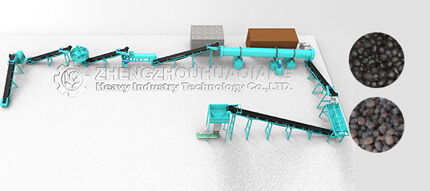
To address the above causes, comprehensive prevention and control measures must be implemented across all stages, from production and storage to subsequent processing. In the production stage, the primary focus should be on optimizing the drying process, strictly controlling the finished product moisture content below 12%. Low-temperature drying technology, combined with the precise temperature control system of the bio-organic fertilizer production line, should be employed to avoid damaging beneficial microorganisms with high temperatures while ensuring uniform moisture distribution and preventing localized dampness and clumping. Simultaneously, granulation parameters should be optimized, selecting appropriate granulation equipment to ensure round and uniform granules. Environmentally friendly anti-caking liquid or powdered anti-caking agents can be added to form a hydrophobic protective film, preventing granule adhesion.
Management during storage and transportation is equally crucial. Woven bags lined with plastic film should be used for sealed packaging to prevent external moisture intrusion. The storage environment must be dry and well-ventilated, with relative humidity controlled below 60%, avoiding drastic temperature and humidity fluctuations. Stacking height should not be excessive to reduce pressure on lower granules, and regular inspection and turning are necessary to prevent long-term clumping.
For finished products that have already clumped, a specialized agglomeration breaker can be used to break up the bagged clumps non-destructively through high-frequency vibration, eliminating the need to unpack the products and avoiding fertilizer waste and contamination. After breaking up the clumps, they should be promptly resealed and stored. Furthermore, a full-process quality inspection mechanism should be established to regularly test indicators such as moisture content and particle size of the finished product, and production parameters should be adjusted promptly to reduce the risk of clumping from the source.
In summary, clumping of finished bio-organic fertilizer products is preventable and reversible. The key lies in strictly controlling moisture content, optimizing processes, and standardizing storage. Enterprises need to implement targeted measures based on their own production conditions to improve product stability, enhance market competitiveness, and promote the high-quality development of bio-organic fertilizer production lines.
_800x600.jpg)
_800x600.jpg)