Organic fertilizer is a core fertilizer for modern agriculture in improving soil and promoting green planting. Many people only know the effects of the two types of organic fertilizer, but they don't understand that the core difference lies in the production process. Although bio-organic fertilizer and conventional organic fertilizer use similar raw materials, their production processes, technological standards, core processing techniques, and finished product requirements are completely different, resulting in significant differences in their functions.
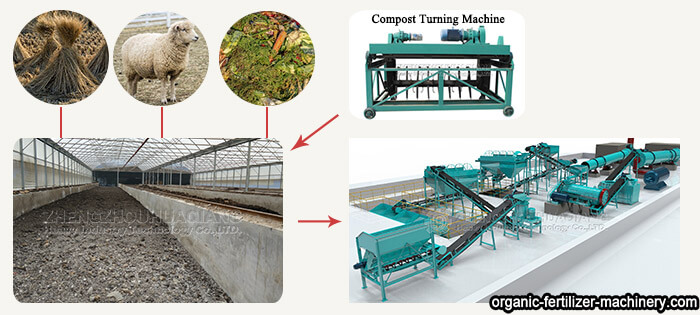
The requirements for raw material pretreatment differ significantly. Conventional organic fertilizer production has a lower barrier to entry, mainly using livestock and poultry manure, crop straw, and agricultural waste as raw materials. It only requires simple sorting and impurity removal to remove large impurities before entering the fermentation stage, with no strict requirements on the microbial community or purity of the raw materials. Bio-organic fertilizer, on the other hand, has strict control over raw materials. It not only requires thorough harmless treatment of the raw materials but also strict control over the content of heavy metals and harmful bacteria to avoid inhibiting the survival of beneficial bacteria and laying a good foundation for subsequent inoculation processes.
The fermentation and maturation process is the fundamental difference. Conventional organic fertilizers undergo high-temperature composting, relying on natural microbial communities to decompose organic matter. High-temperature fermentation kills insect eggs and weed seeds, requiring only thorough decomposition and elimination of root burn risks. The fermentation cycle is short and management is less stringent. Bio-organic fertilizers, on the other hand, undergo more refined initial decomposition, employing a segmented, temperature-controlled fermentation process. This precisely regulates temperature, humidity, and oxygen levels, ensuring thorough decomposition while maximizing the preservation of organic matter activity and preventing excessive nutrient loss.
The core difference lies in the specialized processing procedures. After fermentation, conventional organic fertilizers only require crushing, mixing, granulation, drying, and packaging, with no additional steps. The finished product contains only organic matter and basic nutrients. Bio-organic fertilizers, after decomposition and cooling, are specifically inoculated with beneficial live bacteria such as Bacillus subtilis and nitrogen-fixing bacteria. The entire process is low-temperature and humidity-controlled, preventing high temperatures from killing the bacteria. Finally, low-temperature solidification and packaging ensure the finished product contains sufficient active beneficial bacteria.
In summary, conventional organic fertilizer production focuses on the harmless treatment of waste materials, with a simple and extensive process; bio-organic fertilizer production emphasizes activation and efficiency enhancement, with a refined process and strict standards. Different production processes allow ordinary organic fertilizers to primarily improve the soil, while bio-organic fertilizers have multiple functions such as nourishing the soil, activating the soil, and preventing diseases, making them suitable for different planting needs.
_800x600.jpg)
_800x600.jpg)