
Bio-organic fertilizer production differs from that of conventional compound fertilizers; the materials contain live bacteria, have high organic matter content, and exhibit significant moisture fluctuations. The core principles for equipment selection are preserving bacterial viability, ensuring stable granule formation, and preventing breakage. Different granulation technologies have their respective pros and cons, so plant construction requires a comprehensive choice based on raw materials, production capacity, and budget.
The disc granulator is a common choice for small and medium-sized organic fertilizer plants. It relies on the rotation of a disc to cause materials to roll and agglomerate into spheres; it features a simple structure, low investment costs, and ease of operation. However, its drawbacks are evident: it requires fine raw materials, produces granules with uneven roundness, generates significant dust during production, and the heat generated by high-speed friction can slightly affect bacterial viability. It is suitable for manufacturers with low production capacities who sell granular products alongside powdered organic fertilizers.
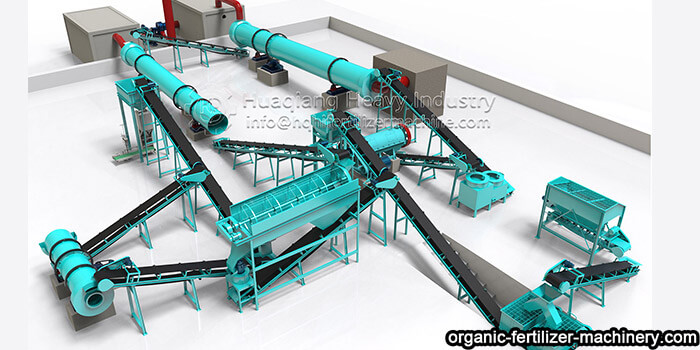
The rotary drum granulator is a mainstream choice for medium-to-large production lines. The slow rotation of the drum causes materials to tumble and agglomerate, offering high output and stable continuous production; it accommodates various fermented raw materials such as livestock manure and crop straw. The equipment operates gently with minimal temperature rise, effectively preserving live bacteria. Its downsides include a large footprint, the need for auxiliary drying and cooling systems, and higher infrastructure investment costs; it is best suited for large-scale plants with an annual output exceeding 10,000 tons.
The flat-die pellet machine is the preferred choice for processes that do not require drying. It forms granules by using pressure rollers to force material through die holes; no binders are needed, moisture content requirements are low, and the resulting granules are hard, durable, and generate little recycle material. The entire process takes place at low temperatures, causing virtually no damage to the bacterial cultures. Its limitations are that the granules are short cylinders with average roundness, and the maximum production capacity is lower than that of rotary drum granulators; it is suitable for projects with limited budgets that wish to avoid installing drying equipment.
There is also the new type organic fertilizer granulator, specifically designed for materials with high organic matter content. Integrating crushing and granulation, it is highly adaptable to fermented and decomposed manure and offers a high pellet formation rate. Balancing production capacity with the preservation of beneficial microbial strains, it has become a popular choice for newly established bio-organic fertilizer projects in recent years.
In summary: a disc granulator is a suitable choice for small-scale plants or limited budgets; a drum granulator is preferred for large-scale production (tens of thousands of tons); a flat-die pellet machine is recommended if you wish to avoid installing a drying line and prioritize the activity of microbial strains; and a new type of organic fertilizer granulator is suitable for raw materials with high organic matter content. Huaqiang Heavy Industry offers one-stop equipment selection solutions for bio-organic fertilizer production lines, tailored to specific raw material types and site conditions.
_800x600.jpg)
_800x600.jpg)
_800x600.jpg)
_800x600.jpg)