The disc fertilizer granulator machine is an indispensable core piece of equipment in the production of organic and compound fertilizers. It is primarily used to process powdery or lumpy raw materials into round, uniform granular fertilizers. By resolving common issues associated with powdery fertilizers—such as a tendency to cake, difficulties in storage and transport, and low utilization rates—it serves as a critical link connecting raw material processing with finished product packaging. Thanks to its simple structure and ease of operation, it has become the preferred choice for small-to-medium-scale fertilizer manufacturers, with applications spanning various sectors including agriculture and the chemical industry.
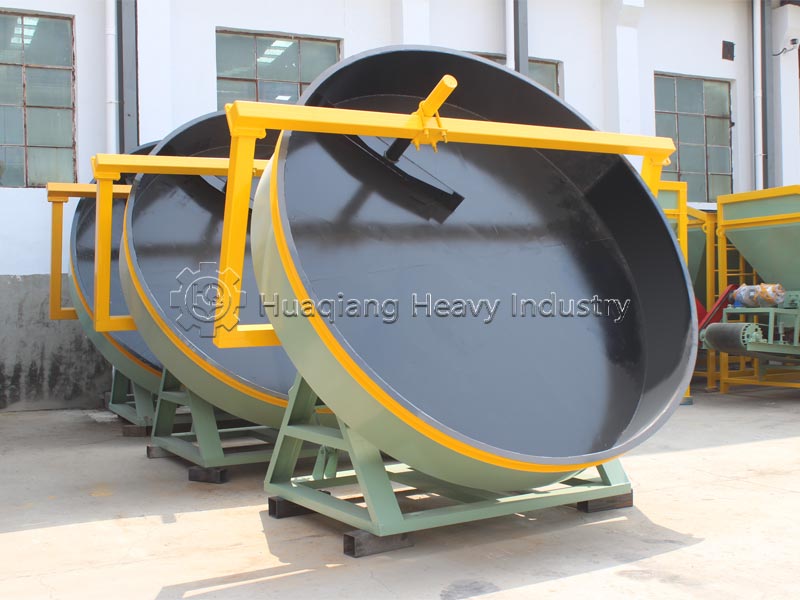
The core operating principle of this equipment is rooted in the synergistic interplay of mechanical forces, functioning much like the clever process of "rolling a snowball." The main body of the machine consists of a rotating disc with an adjustable tilt angle (typically set between 45° and 60°). During operation, fermented powdery raw materials (such as livestock and poultry manure, or spent mushroom substrate) are fed onto the disc. As the disc rotates at a speed of 20–40 revolutions per minute (r/min), the raw materials tumble and roll along the disc wall under the combined influence of centrifugal force, friction, and gravity. Simultaneously, a spraying system uniformly applies a binding agent, causing the raw materials to gradually agglomerate into spherical granules. By adjusting the disc's rotation speed and tilt angle, the size of the granules can be precisely controlled within a range of 2 to 8 millimeters.
A standout advantage of the disc fertilizer granulator machine is its high cost-effectiveness and strong adaptability. Its structure is simple—comprising a disc, a transmission mechanism, and a spraying system—and its acquisition cost is typically only 30% to 50% of that of comparable equipment. Furthermore, general laborers can master its operation after only brief training, and the machine requires minimal maintenance. It maintains a stable granulation rate of 80% to 85%, producing granules that are highly spherical, smooth-surfaced, and possess excellent flowability—qualities that facilitate both packaging for sale and effective application in the field.
The equipment is suitable for a wide array of scenarios, making it particularly ideal for small-to-medium-scale fertilizer production lines with an annual output of 10,000 to 50,000 tons. It is well-suited for processing organic fertilizer raw materials with a moisture content of 25%–35% and a fiber content of 30%–50%. Whether utilized by rural cooperatives and family farms for their own internal production, or by startup fertilizer enterprises for large-scale processing, it consistently delivers excellent performance. Moreover, it can be employed to granulate various other types of fertilizers—including compound fertilizers and biomass-based fertilizers—thereby playing a pivotal role in the resource-efficient utilization of agricultural waste.
As a classic piece of equipment with a history of over 50 years, the disc fertilizer granulator machine—despite its inherent limitation of a relatively low production capacity ceiling—can be effectively optimized through integration with pre-processing equipment. Leveraging its advantages of low cost and high efficiency, it has driven the large-scale development of the organic fertilizer industry, providing robust equipment support for green agricultural production as well as for enhancing quality and efficiency.
_800x600.jpg)
_800x600.jpg)