
With the rapid development of ecological agriculture, bio-organic fertilizers—distinguished by their ability to improve soil, enhance crop quality, and reduce environmental pollution—are gradually replacing traditional chemical fertilizers to become the new preferred choice in agricultural production. The production of bio-organic fertilizers centers on the resource utilization of organic waste; by integrating microbial fermentation processes, it effectively transforms "waste into treasure," yielding products of both environmental and agricultural value. Specialized bio-organic fertilizer production lines provide efficient operational assurance for this process, serving as a critical pillar in driving the green transformation of agriculture.
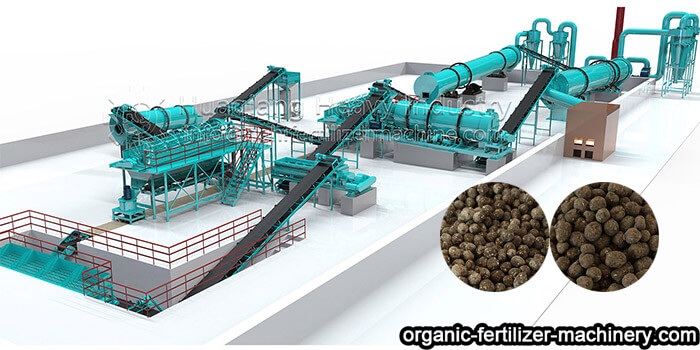
The core of bio-organic fertilizer production lies in raw material pretreatment, which serves as the fundamental basis for ensuring the efficacy of subsequent fermentation. Raw materials are primarily selected from organic waste sources—such as livestock and poultry manure, crop straw, and spent mushroom substrate—and undergo rigorous screening to eliminate substandard inputs containing excessive heavy metals or antibiotics, thereby ensuring compliance with industry standards. The pretreatment phase involves steps such as crushing, impurity removal, and moisture adjustment; specifically, materials like straw are crushed to a particle size of less than 2 cm, and the moisture content of the raw mixture is adjusted to between 50% and 55%. Furthermore, auxiliary materials—such as rice husks and sawdust—are incorporated to maintain the carbon-to-nitrogen ratio within the optimal range of 25:1 to 30:1, thereby creating favorable conditions for microbial proliferation.
Microbial fermentation constitutes the technical core of the production process, with the two-stage aerobic fermentation method currently being the mainstream approach. First, the pretreated raw materials are inoculated with a composite microbial agent and enter the high-temperature fermentation stage, where the temperature is maintained between 55°C and 65°C for a minimum of five days to effectively eradicate pathogens, insect eggs, and weed seeds present in the raw materials. Subsequently, the process transitions to the medium-temperature fermentation stage, with temperatures controlled between 35°C and 45°C to facilitate the formation of humus. During this phase, regular turning of the compost piles using compost turning machines—combined with oxygen supply via aeration systems—is essential to ensure uniform fermentation throughout the batch. By leveraging the action of the composite microbial agents, the total fermentation cycle can be shortened to between 7 and 15 days, representing a 50% increase in efficiency compared to traditional fermentation methods.
Following fermentation, the material undergoes post-processing and quality control procedures to qualify as a finished product. The process begins with an aging treatment to further stabilize nutrient levels and enhance fertilizer efficacy. This is followed by crushing and screening; for powdered products, the fineness is refined to pass through an 80-mesh sieve or finer, while granular products undergo additional steps—including granulation, low-temperature drying, and cooling—to ensure the final product's moisture content remains at or below 30%. During critical stages, functional microbial agents must be added at temperatures below 40°C to prevent high heat from deactivating the microbial strains, thereby ensuring that the finished product meets the required standards for effective viable bacterial count. Finally, following a successful quality inspection, the product undergoes quantitative packaging, marking the completion of the entire production process.
Currently, bio-organic fertilizer production technology is undergoing an upgrade toward greater intelligence and lower carbon emissions; Internet of Things (IoT) technology enables the real-time regulation of fermentation temperature and humidity, while nano-coating technology enhances fertilizer utilization efficiency. Mastering this production technology not only facilitates the resource-efficient utilization of organic waste but also supplies the agricultural sector with green, high-efficiency fertilizers, thereby contributing to the improvement of arable land quality and the sustainable development of agriculture.
_800x600.jpg)
_800x600.jpg)
_800x600.jpg)
_800x600.jpg)