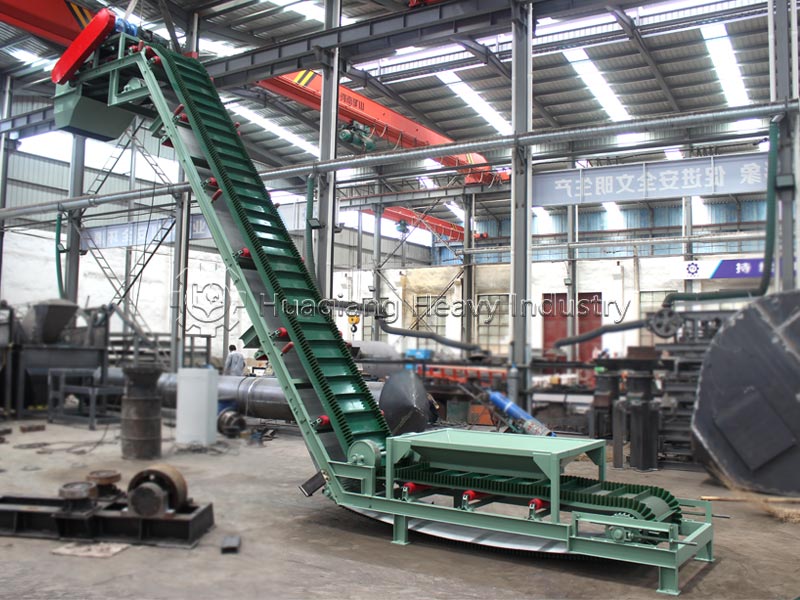
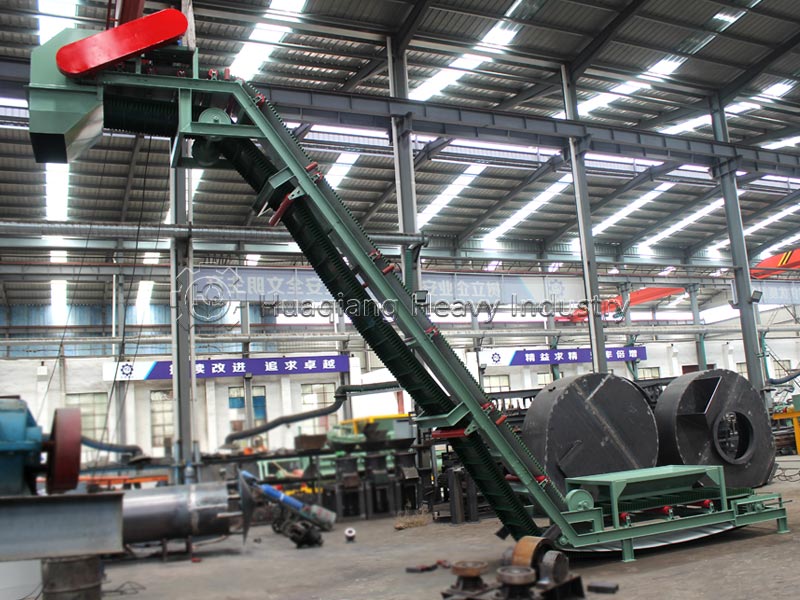
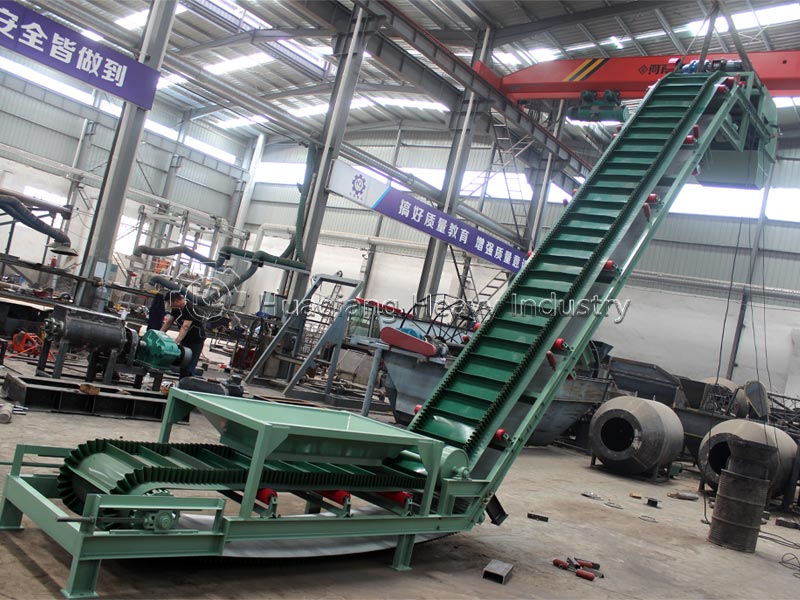
In production lines for fertilizers, mining, and building materials, the lifting and transfer of materials is a critical factor determining the overall operational fluidity. The large angle belt conveyor is specialized continuous conveying equipment designed to handle steep inclines. Drawing on extensive on-site experience in the fertilizer industry, Huaqiang Heavy Industry has repeatedly optimized this model, making it ideal for material transfer scenarios characterized by limited space and significant elevation differences.
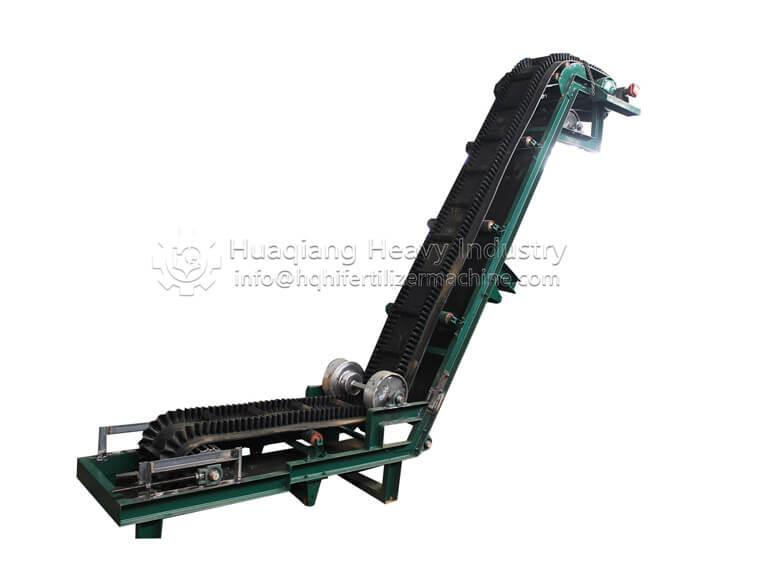
A large wheel belt conveyor features flexible rubber corrugated sidewalls bonded to both sides of a standard base belt, with high-strength elastic cross-cleats bonded transversely between them; the combination of these cleats and sidewalls creates a series of box-like hopper units. Once material falls into these hoppers, it is contained and restrained by the structure, preventing roll-back or spillage even at steep angles. This enables stable conveying across a range of 0° to 90°, allowing for a direct transition from horizontal sections to inclined or even vertical lifting without the need for intermediate transfer points.
The main components of the machine include:
Corrugated sidewall conveyor belt: The core wear part of the system, consisting of a base belt, corrugated sidewalls, and transverse cleats (available in T, C, and TC types). Selection is based on material particle size, inclination angle, and capacity; belts made of special rubber compounds can be customized for conveying corrosive or high-temperature materials.
Drive unit: Comprises a motor, gearbox, and coupling, available in enclosed or open configurations. High-power models can be equipped with dual drives, and variable-frequency drive (VFD) motors may be used to adjust output capacity based on operational needs.
Pulley assembly: Includes drive pulleys, bend pulleys, and hold-down wheels. Hold-down wheels are used at convex curve sections to prevent belt edge curling and material spillage.
Idler and frame system: Includes carrying idlers, return idlers, and support frames; these support the weight of the belt and material, ensuring smooth belt operation.
Tensioning device: Typically a screw-type tensioner; it ensures proper belt tension to prevent slippage and is a crucial component for stable operation.
Auxiliary accessories: Belt cleaners, material covers, belt sway (misalignment) switches, and braking devices; sealed dust covers can be installed for operations involving high dust levels.
Large wheel belt conveyors are widely used throughout complete =organic fertilizer production lines. They can feed raw materials—after mixing in a twin-shaft mixer—into rotary drum or disc granulators, transfer granules to dryers, move dried material to coolers, and link up with rotary screeners for granule classification. They are also used to transport finished fertilizer to storage silos or truck-loading stations; this eliminates the need for repeated material transfers and helps preserve granule integrity. As small- and medium-sized organic fertilizer plants often have limited floor space, this equipment integrates well with existing layouts, avoiding the need for major facility renovations.
In addition, these conveyors are extensively used in sectors such as mining, coal, construction materials, chemicals, grain processing, and port-based bulk material handling.
For most bulk material production lines facing significant elevation changes and limited space, large angle belt conveyors offer a highly cost-effective continuous conveying solution. Whether for a new fertilizer production line or the upgrade of an existing one, providing the equipment manufacturer with comprehensive details about the site conditions is essential to obtaining a solution truly tailored to your facility.