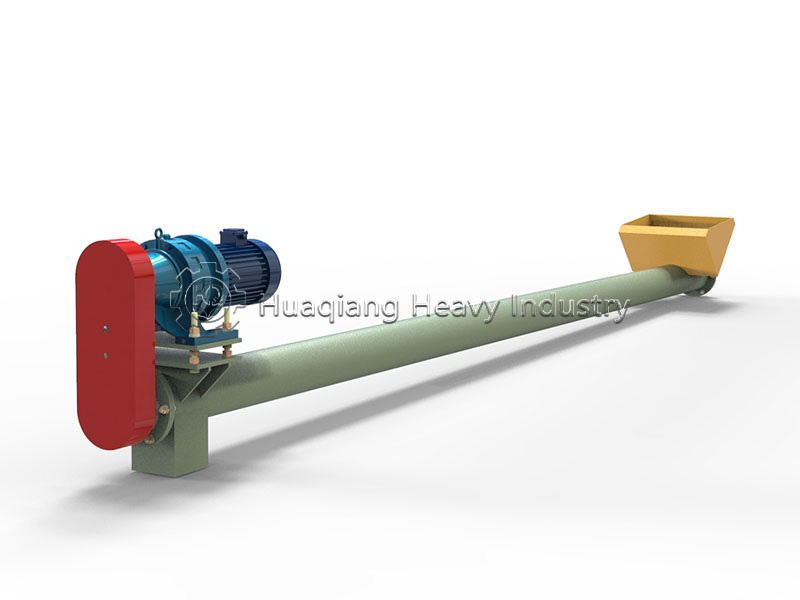
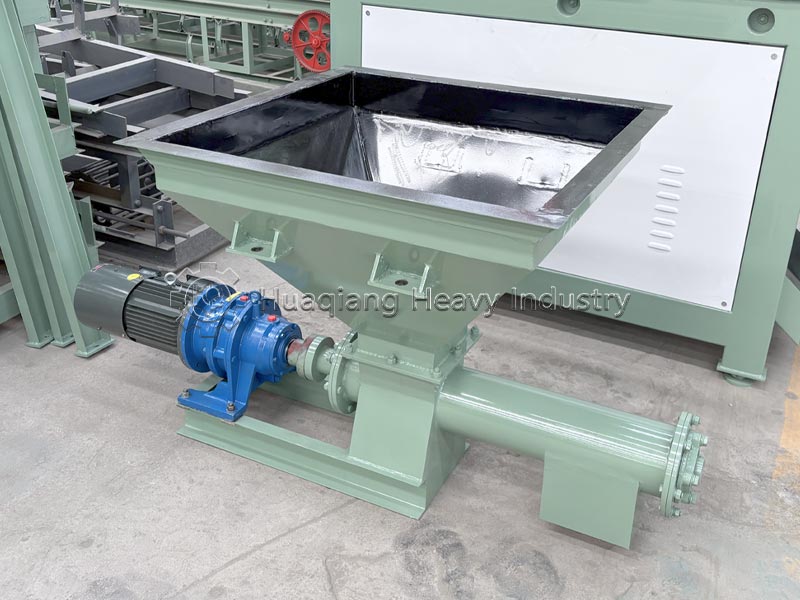
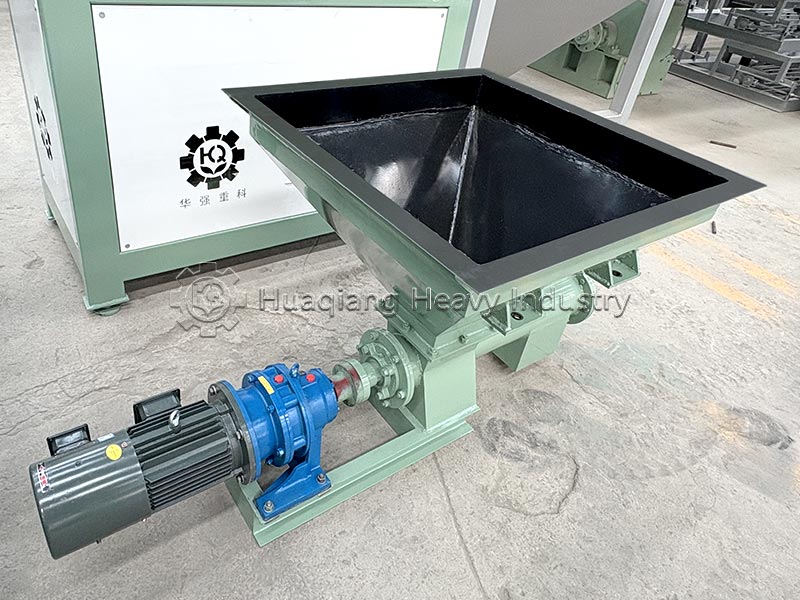
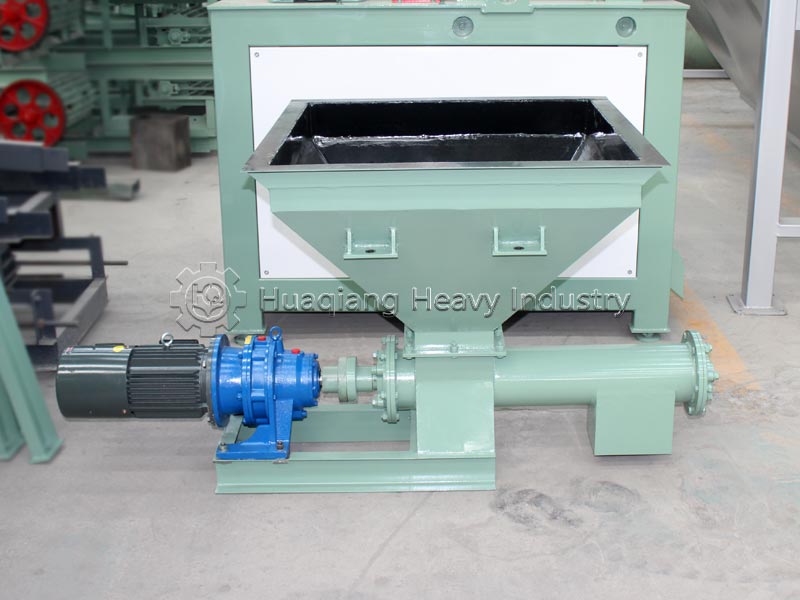
A screw conveyor is a type of continuous conveying machinery that operates without a traction element; it relies on a motor to drive the continuous rotation of internal helical flights. The thrust from these flights pushes powdery or granular materials axially forward within the trough—much like a nut moving along a rotating threaded rod. Due to gravity and friction against the trough walls, the material does not rotate along with the flights, thereby ensuring stable material feeding.
Designed to withstand the corrosive, dusty, and sticky material conditions typical of fertilizer workshops, the screw conveyor manufactured by Huaqiang Heavy Industry consists of six major components, with material specifications customizable for each part:
Drive assembly: Includes a gear motor and coupling; overload protection is available, and variable-speed motors can be selected to control feeding rates when handling wet organic fertilizer raw materials.
Screw shaft and flights: Options include solid flights, ribbon flights, and paddle-style flights; ribbon flights are preferred for wet chicken or cattle manure to minimize the risk of clogging.
Conveyor housing: Available in open U-shaped trough or enclosed tubular designs; fully enclosed tubular housings are used for dusty chemical fertilizers to prevent dust emissions in the workshop.
Hanger bearings: Installed for conveyors exceeding 3 meters in length to support the weight of the screw shaft and reduce shaft vibration and wear.
Inlet and discharge ports: Support multi-point feeding and discharging, facilitating material distribution across multiple processing lines in the fertilizer workshop.
Sealing covers and inspection hatches: Allow workers to easily clean out residual fermented manure or fertilizer clumps from the housing.
Fertilizer manufacturing is the primary industry utilizing screw conveyors. Conveying equipment is required to transport materials at virtually every stage of the process—from raw material pretreatment, batching and mixing, granulation, and drying/cooling to final product packaging:
Organic fertilizer plants: Conveying chicken manure, cattle manure, powdered straw, humus soil, and fermented compost;
Compound fertilizer plants: Conveying NPK raw material powders, additives, and semi-finished granules;
Beyond the fertilizer industry, this equipment is also widely used in grain processing, the transport of chemical powders, the cement and building materials sector, and food waste treatment.
Based on experience working with hundreds of domestic and international fertilizer processing plants, Huaqiang Heavy Industry summarizes the equipment's advantages as follows:
Compact footprint: The unit fits into tight spaces between workshop equipment and supports inclined, horizontal, or vertical installation.
Dust control: The enclosed design minimizes dust emissions; 304 stainless steel construction is available for handling corrosive fertilizers.
Precise feeding: It provides consistent, metered feeding to granulation equipment, ensuring uniform granule quality.
Simple design: With fewer components and low maintenance requirements, it supports long-term, continuous operation.
Multi-point discharge: A single conveyor can feed multiple machines simultaneously, simplifying the workshop's material handling layout.
However, there are also limitations: Conveying distance is limited, so very long runs require segmented installation; highly sticky or large, hard materials can cause blockages and require pre-processing (such as crushing) before conveying.
| Model |
Screw Diameter
(mm) |
Rotation Speed
(r/min) |
Capacity
(m³/h) |
|
LS160 |
160 |
112 | 9.7-3.2 |
| 90 | 7.8-2.6 | ||
| 71 | 6.2-2.1 | ||
|
56**
|
4.9-1.6 | ||
|
LS200 |
200 |
100 | 16.9-5.6 |
| 80 | 13.5-4.5 | ||
| 63 | 10.7-3.6 | ||
|
50**
|
8.5-2.8 | ||
|
LS250 |
250 |
90 | 29.9-9.9 |
| 71 | 23.5-7.8 | ||
|
56**
|
18.5-6.2 | ||
|
45**
|
14.9-5.0 | ||
|
LS315 |
315 |
80 | 52.9-17.6 |
| 63 | 41.6-13.9 | ||
|
50**
|
33.1-11.0 | ||
|
40**
|
26.4-8.8 | ||
|
LS400 |
400 |
71 | 85.3-28.2 |
| 56 | 67.3-22.4 | ||
|
45**
|
54.1-18 | ||
|
36**
|
43.2-14.4 |