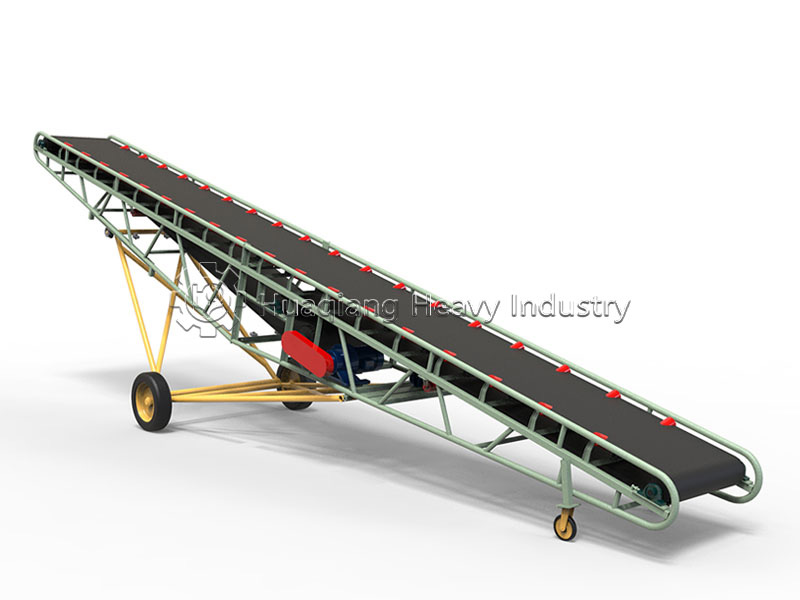
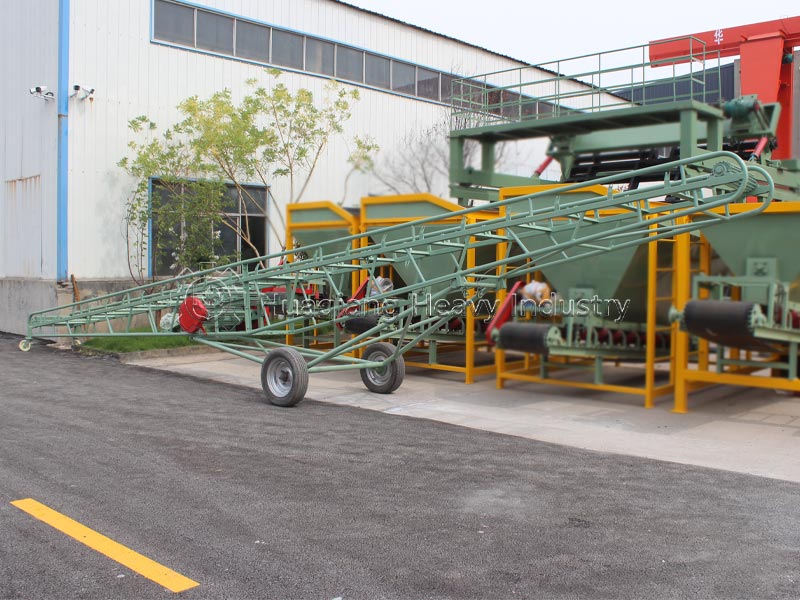
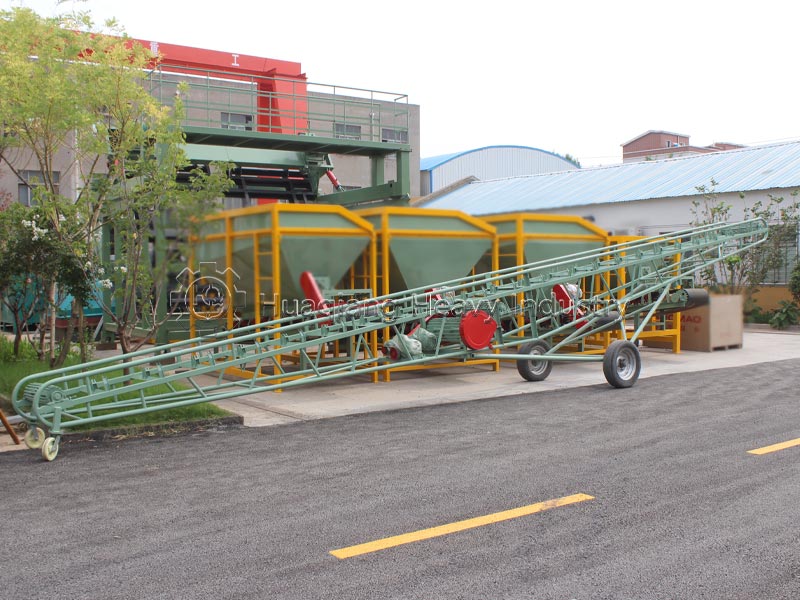
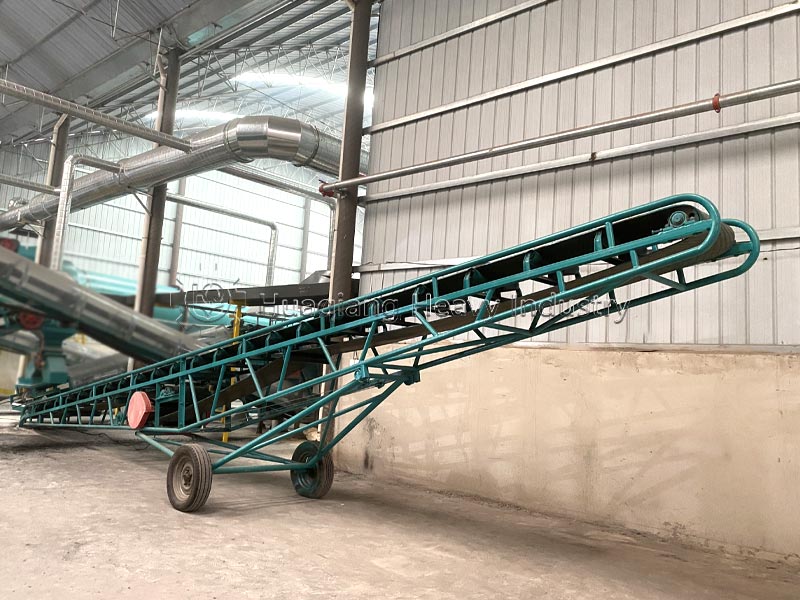
The mobile belt conveyor is a type of relocatable, continuous conveying equipment that utilizes a rubber belt for both traction and load-bearing functions; equipped with pneumatic wheels and swivel casters at the base, it allows operators to easily push the unit to different work locations.
Once the drive motor starts, power is transmitted to the drive pulley; the friction between the pulley and the belt drives the continuous conveyor belt to circulate. Bulk livestock manure, decomposed organic fertilizer, NPK compound fertilizer granules, and bagged finished fertilizer are placed on the belt surface and transported to the discharge outlet for unloading.
The tail-end bend pulley is equipped with a screw tensioning device to adjust belt tension as needed, preventing belt misalignment caused by fertilizer dust; side guide plates provide protection should the belt drift off-track.
Thanks to their flexibility and adaptability, mobile belt conveyors play a vital role across various industries:
Ports and terminals: Loading, unloading, and short-distance transfer of bulk materials such as coal and ore.
Coal yards and mines: Transporting materials like coal, ore, and slag.
Construction sites and aggregate yards: Transporting construction materials such as sand, gravel, and cement.
Warehouses and farms: Handling operations for grain, fertilizers, bagged goods, and similar items.
Stations and freight yards: Short-distance transport and loading/unloading of packaged goods.
Multiple units can also be combined, or integrated with other conveying equipment, to form horizontal or inclined conveyor systems.
The most notable advantage of mobile belt conveyors is their mobility. Equipped with wheels at the base, they can be moved easily and flexibly, allowing for quick transitions between different work sites. For operations where loading and unloading locations frequently change, this feature significantly reduces the cost of purchasing additional equipment.
Most mobile belt conveyors feature automatic lifting capabilities, allowing adjustments based on material pile height, vehicle bed height, or specific operational needs. Models exceeding 10 meters in length offer adjustable inclination angles, enabling them to handle conveying tasks across varying slopes.
Driven by electric drums, mobile belt conveyors can operate continuously and stably even under full load. 4. Lightweight structure and compact footprint
The equipment utilizes a tubular steel structure that is both lightweight and aesthetically pleasing. Compared to traditional conveying equipment, the physical footprint is reduced by over 50%, making it particularly suitable for space-constrained environments.
As an original manufacturer of complete fertilizer production equipment, we customize mobile belt conveyor specifications based on your facility's dimensions, the type of material to be conveyed, and the required conveying distance and height. We provide comprehensive equipment solutions for organic fertilizer production lines—covering everything from raw material crushing, mixing, and granulation to the conveying and loading of the finished product. Please contact our customer service team for inquiries, equipment case studies, actual footage, and technical specifications.
| Length | -6(-10)M | -6(-10)M | -6(-10)M | -10(11-)M | -10(11-)M | -10(11-)M |
| Width | 500 | 650 | 800 | 500 | 650 | 800 |
| Height | 80 | 80 | 100 | 0 | 0 | 0 |
| Power | 2.2(3) | 3(4) | 5.5(7.5) | 3(4) | 3(4) | 5.5(7.5) |
| Rotation Speed | 72 | 72 | 55 | 55 | 55 | 55 |
| Transport volume | 7-10 | 10-18 | 15-20 | 10-19 | 13-25 | 20-45 |
| Angle | 20-60 | 20-60 | 20-60 | 0-23 | 0-23 | 0-23 |
| Transmission mode | Direct connection of reducer | Direct connection of reducer | Direct connection of reducer | Trigonometric belt | Reducer chain | Reducer chain |