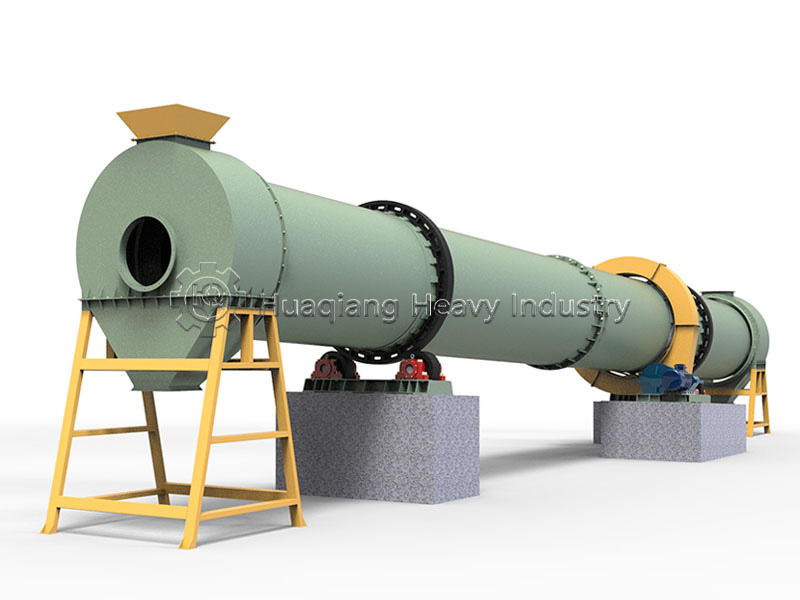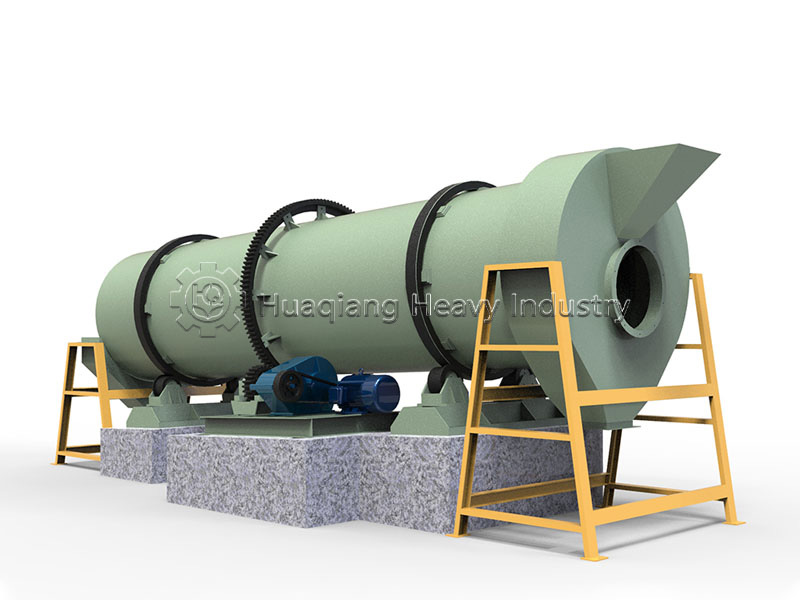
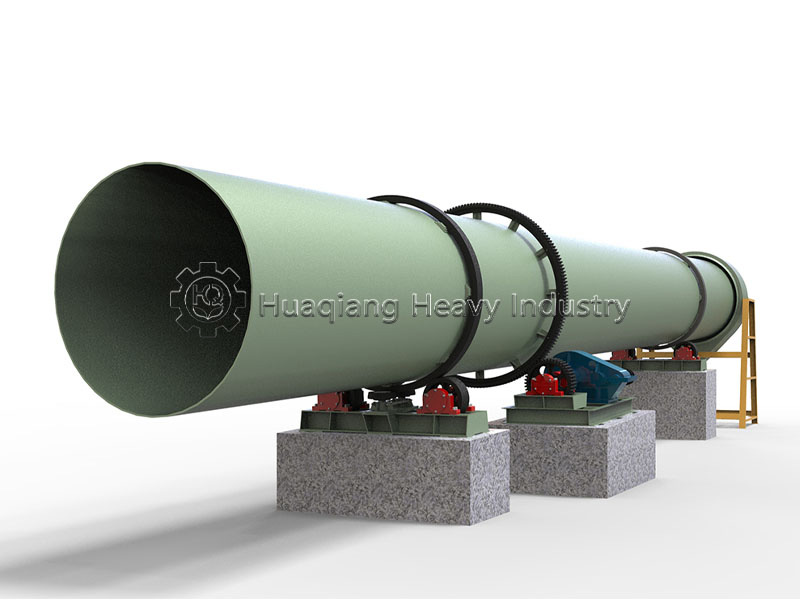
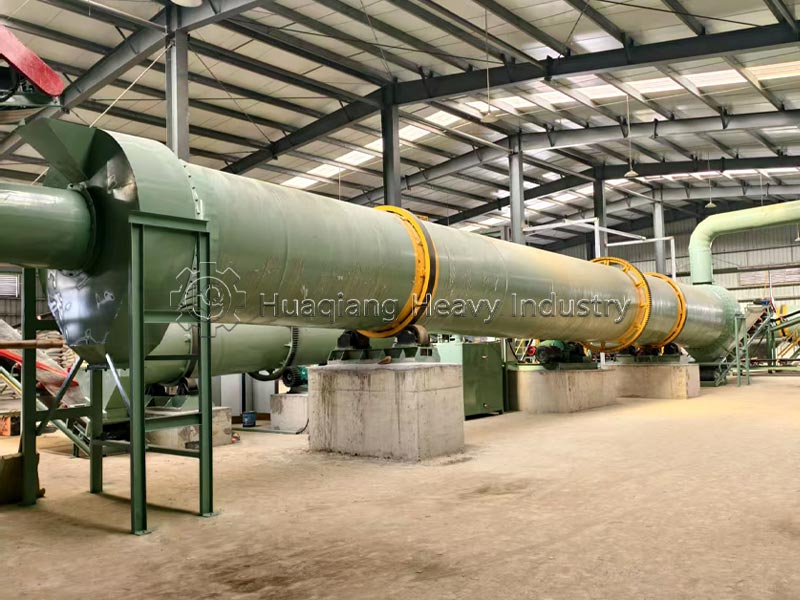
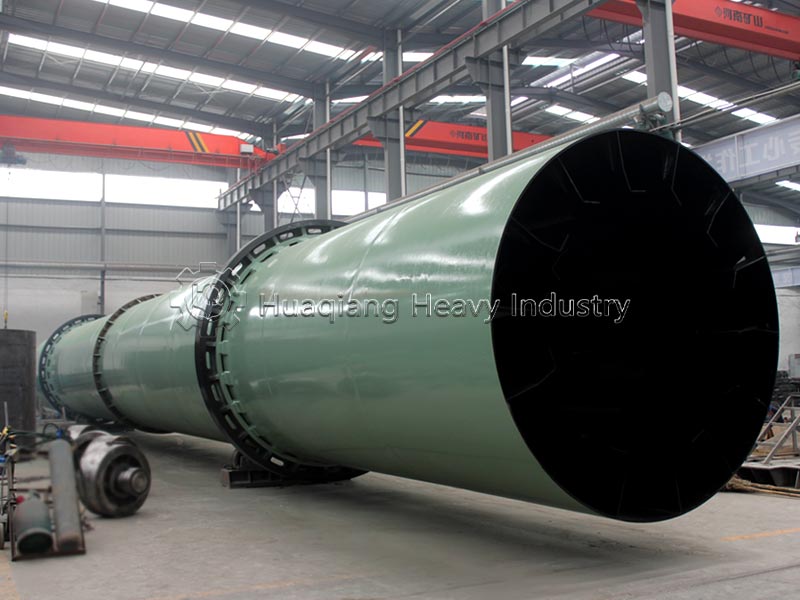
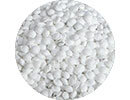
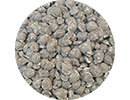
The drum fertilizer cooler (also known as a drum cooler) is a critical piece of equipment in fertilizer production lines. Typically paired with a drum dryer, its primary function is to forcibly cool fertilizer granules after high-temperature drying; this process lowers the granule temperature and further reduces moisture content, thereby ensuring the quality and storage stability of the finished product.
In production lines for organic, compound, and blended fertilizers, the drum fertilizer cooler plays a pivotal role in cooling and stabilizing the granules. Fertilizer granules exiting the dryer typically range from 60℃ to 80℃ without timely cooling, they are prone to caking and degradation, which can also disrupt subsequent screening and packaging operations. By utilizing physical cooling methods, the drum cooler brings the discharge temperature below 40℃, ensuring the granules meet strength standards and preserving the integrity of their active ingredients.
The working principle of a drum fertilizer cooler is based on two core mechanisms: counter-current heat exchange and mechanical agitation.
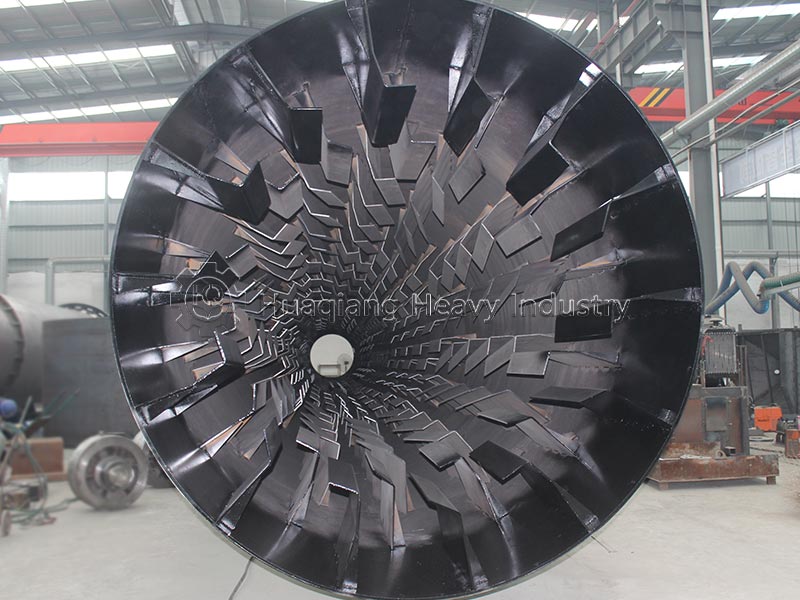
The main body of the equipment consists of an inclined rotary drum equipped with internal lifting flights (also known as lifters or scoops). During operation, high-temperature fertilizer granules enter the drum from the feed end, while cold air is introduced from the discharge end; the two flow in opposite directions within the drum. This counter-current design ensures that the cold air first contacts the material about to be discharged, resulting in higher cooling efficiency.
The drive system utilizes a main motor to power the drive shaft via a belt and speed reducer; a split gear then meshes with a large girth gear to drive the drum's steady rotation. As the drum rotates, the lifting flights continuously lift and drop the material, creating a uniform curtain of particles. During this process, the fertilizer granules come into full contact with the cold air, allowing heat to transfer rapidly and ensuring even cooling. Simultaneously, an associated induced-draft fan accelerates airflow within the drum, further enhancing cooling efficiency.
In short, the drum cooler achieves the cooling and partial dewatering of fertilizer granules in the shortest possible time through the combined action of counter-current cold airflow and mechanical agitation.
The drum cooler is typically positioned after the dryer and before the screening machine. A complete fertilizer production process generally comprises: raw material crushing—batching and mixing —granulation —rotary drying —rotary cooling —screening—coating —packaging.
Although the cooling stage may appear simple, it directly impacts the quality of the final product: improper temperature control can lead to granule caking, while excessive residual moisture affects the fertilizer's shelf life. Therefore, selecting a reliable drum cooler is crucial for ensuring the stable operation of the entire fertilizer production line.
When selecting equipment, it is advisable to consider factors such as material type, daily processing capacity, and site conditions, while also allowing for a 10%-20% capacity margin. Priority should be given to professional equipment manufacturers that offer comprehensive after-sales service and the ability to provide customized solutions.
Based on technical data from various equipment manufacturers, drum fertilizer coolers offer the following significant advantages:
The equipment handles capacities ranging from 1.0 to 40 t/h, meeting the needs of operations ranging from small-scale organic fertilizer plants to large-scale compound fertilizer production lines. Faster cooling directly reduces labor intensity and boosts output.
Through counter-current heat exchange and thorough agitation by internal lifting flights, fertilizer granules cool evenly, effectively preventing caking. Discharge temperatures are stably maintained below 40°C, ensuring granule strength.
The equipment features a compact structure, a reliable drive system, and simple daily maintenance. Its power configuration is optimized for low energy consumption.
In addition to organic, compound, and blended fertilizer production, drum fertilizer coolers can be used to cool other powdery and granular materials.
| Model | shell | Feed temperature | Discharge temperature | Motor | Decele vators model | |||||
| Inner diam | Length | Inclination | Rotation speed | Model | Power | Rotation speed | ||||
| mm | mm | (0) | r/min | °C | °C | kW | r/min | |||
| LQ10100 | 1000 | 10000 | 2-5 | 4.6 | 60-80 | <40 | Y132m-4 | 7.5 | 1440 | ZQ350 |
| LQ12120 | 1200 | 12000 | 2-5 | 4.6 | 60-80 | <40 | Y132m-4 | 7.5 | 1440 | ZQ350 |
| LQ15120 | 1500 | 12000 | 2-5 | 5 | 60-80 | <40 | Y160L-4 | 15 | 1440 | ZQ400 |
| LQ15150 | 1500 | 15000 | 2-5 | 5 | 60-80 | <40 | Y160L-4 | 15 | 1440 | ZQ500 |
| LQ18160 | 1800 | 16000 | 2-5 | 5 | 60-80 | <40 | Y200 L1-6 | 18.5 | 970 | ZQ500 |
| LQ20200 | 2000 | 20000 | 2-5 | 5 | 60-80 | <40 | Y200 L1-6 | 22 | 970 | ZQ650 |