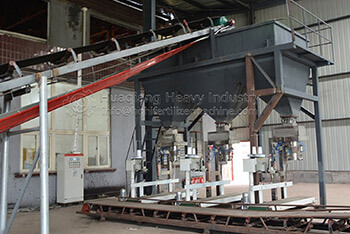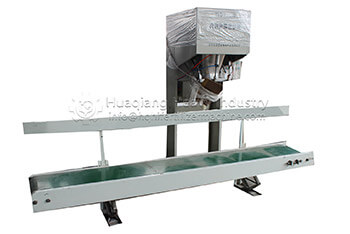
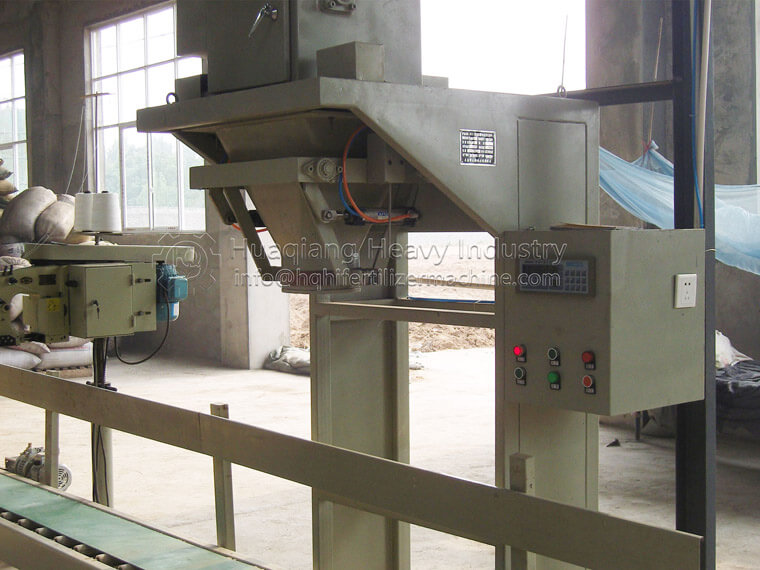
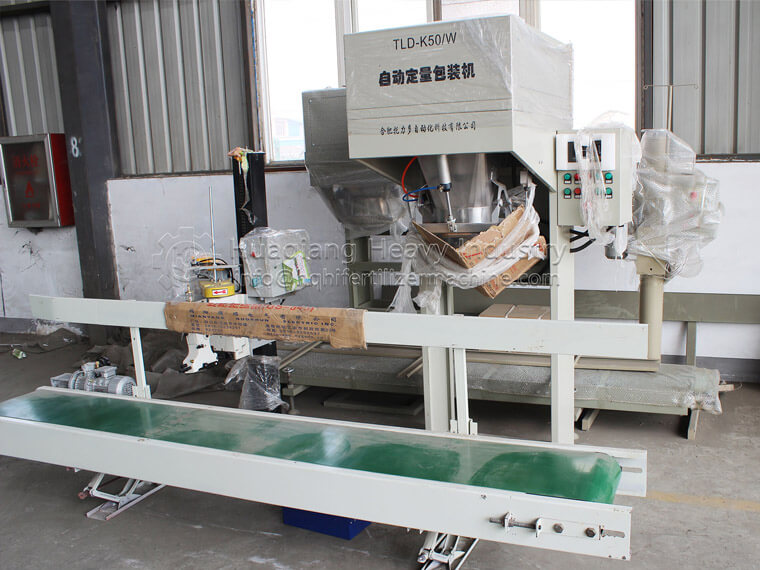
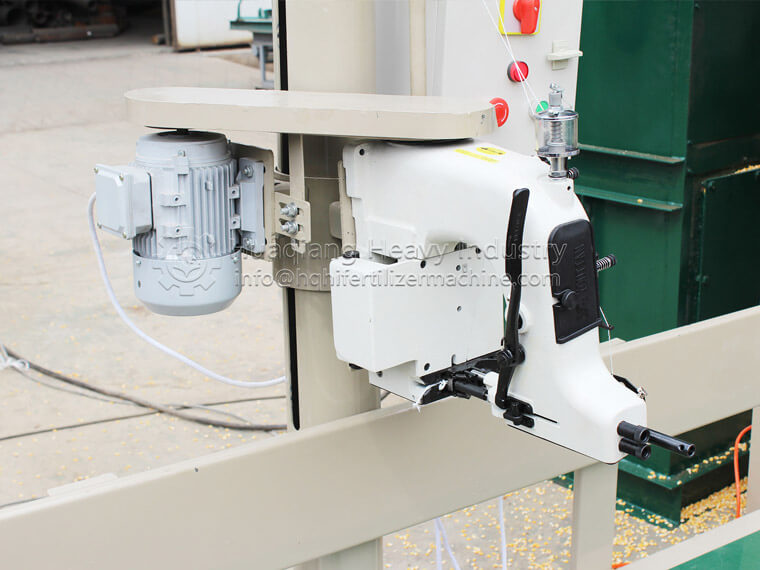
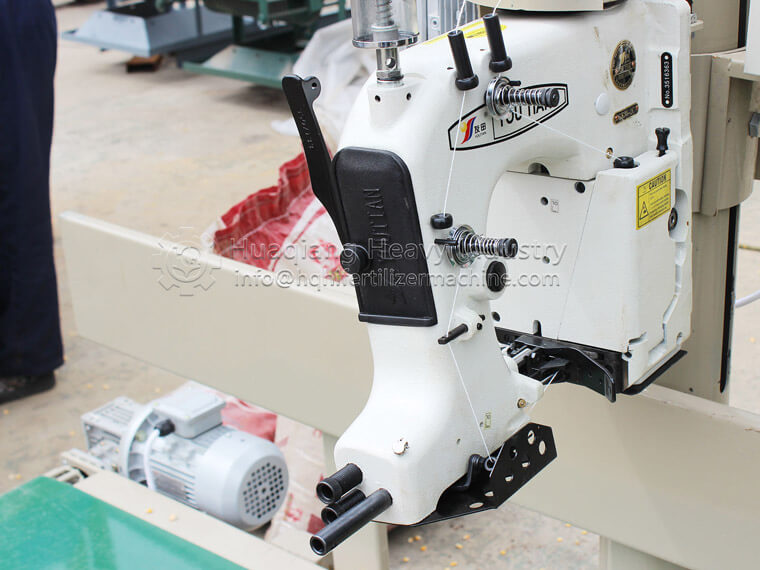
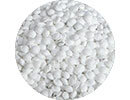
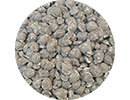
The granular fertilizer packaging machine is an automated, quantitative packaging system specifically designed for granular fertilizers. It meets the weighing and packaging requirements for a wide range of products, including compound fertilizers, phosphate, nitrogen, and potassium fertilizers, as well as bio-organic, slow-release, and controlled-release fertilizers. Integrating functions such as feeding, weighing, bag clamping, conveying, and stitching, the equipment enables a seamless, all-in-one operation from filling to sealing and is compatible with various packaging materials, including woven bags, gunny sacks, paper bags, cloth bags, and plastic bags.
The workflow of a granular fertilizer packaging machine typically involves the following core stages:
Step 1: Material Conveying. Granular fertilizer is transported from the raw material silo to the packaging machine's hopper using equipment such as bucket elevators, belt conveyors, or vibrating feeders; material level control devices are employed to ensure a stable supply.
Step 2: Automatic Weighing and Metering. The packaging scale precisely measures the material according to a preset weight. The equipment utilizes imported high-precision sensors and intelligent weighing controllers, featuring functions such as automatic drop-weight compensation, automatic zero-point tracking, and overshoot detection and suppression. Metering accuracy is typically maintained within ±0.2%.
Step 3: Filling and Sealing. Once measured, the material is discharged into the packaging bag via the filling mechanism. Depending on the bag material, the sealing stage can utilize heat sealing, cold sealing, or bag stitching. Fully automatic systems are also equipped with adjustable-height automatic bag-folding and stitching units.
Step 4: Finished Product Discharge. The sealed bags are transported out via a conveyor belt and can be seamlessly integrated with downstream equipment—such as checkweighers, metal detectors, and palletizing robots—to form a complete packaging and palletizing production line.
Granular fertilizer packaging machines have a very wide range of applications:
Nitrogen fertilizers: Urea, ammonium chloride, ammonium sulfate, ammonium bicarbonate, ammonium nitrate, etc.
Phosphate fertilizers: Single superphosphate, triple superphosphate, monoammonium phosphate, diammonium phosphate, etc.
Potassium fertilizers: Potassium chloride, potassium sulfate, potassium nitrate, etc.
Compound fertilizers: High-concentration compound fertilizers, nitro-based compound fertilizers, sulfur-based compound fertilizers, controlled-release fertilizers, slow-release fertilizers, water-soluble fertilizers, etc.
Organic fertilizers: Composted organic fertilizers, bio-organic fertilizers, microbial fertilizers, etc.
In actual production lines, this equipment is widely used in tower-granulation compound fertilizer lines, bulk blending workshops, extrusion granulation packaging sections, and finished product packaging areas for bio-organic fertilizers.
A packaging machine does not operate in isolation; it represents the final stage of the fertilizer production line. The workflow of a typical NPK compound fertilizer production line is roughly as follows:
Raw material storage — Automatic batching system—crusher—Twin-shaft paddle mixer—Double-roller extrusion granulator—Screening machine—Dryer—Cooler—Coating machine—Granular fertilizer packaging machine—Finished product warehousing.
As can be seen, nearly ten processing steps precede the packaging machine. Issues arising in any of these preceding stages will ultimately manifest during the packaging phase—for instance, incomplete screening might allow oversized granules to enter and jam the machine, or insufficient cooling could cause the fertilizer to clump inside the bags. From this perspective, the packaging machine also serves as a "quality control checkpoint" for the entire production line.
For organic fertilizer production lines, the packaging stage entails a specific requirement: organic fertilizer granules generally have lower hardness than compound fertilizers and are prone to moisture absorption. Consequently, the packaging machine's bag-clamping force and conveying speed must be adjusted accordingly to prevent granule breakage and bag rupture.
| Material |
Granule |
| Weighing Range(kg) |
20-50kg |
| Weighing Speed(bag/h) |
≥500 |
| Dividing value(g) |
20 |
| Level of accuracy |
0.2 |
| Power Supply |
Three-phase four-wire: AC 380V 220V 50Hz (User self-sufficiency) 50Hz (User self-sufficiency) |
| Power Consumption |
0.4~0.6Mpa 1m3/h |
| Gas Source |
It is recommended to select an air compressor with a displacement of 0.25 m3/minor more. |
| Gas Consumption |
0.4~0.6Mpa 1m3/h |
| Working Environment |
-20℃~+40℃ |
| Sensor |
ILGC-200KG-BA (KeLi Electric) |
| Computer Control Instrument |
Intelligent computer controller YH-3D YH-D8 |
| Pneumatic Components |
Yadeke, Taiwan |
| Dust Removal |
Reserve dust outlet |
| Manufacturing Materials |
Contact with the material is made of carbon steel, good fluidity, wear resistance, corrosion resistance, easy to clean. |
| Feeding Method |
Arc valve 3 feed feed |
| Installation size(mm) |
3120*1580*1350 |
| Installation Method |
The scale body is directly docked to the storage bin and does not need to be added as an auxiliary steel frame. Occupied floor space is small and easy to install. |