The product qualification rate is the core competitiveness of a fertilizer production line, directly impacting corporate profits and market reputation. Improving it requires a comprehensive approach across the entire chain, from raw material procurement and production processing to quality control, achieving stable quality through precise control of key stages.
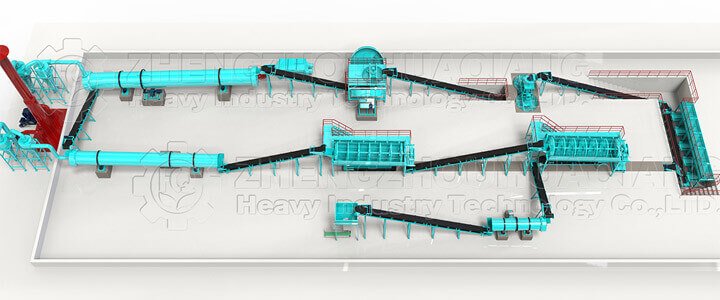
Raw materials are the foundation of quality, necessitating the establishment of strict procurement and pre-treatment standards. For organic fertilizer raw materials, it is necessary to verify indicators such as heavy metal content and moisture content in materials like manure and straw to prevent excessive contaminants. For compound fertilizer raw materials, it is essential to ensure that the purity of nutrients such as nitrogen, phosphorus, and potassium meets standards, avoiding impurities that could affect the quality of the finished product. The pre-treatment stage requires processes such as crushing, sieving, and drying to control the raw material particle size to 20-40 mesh and stabilize the moisture content at 55%-60%, laying the foundation for subsequent processing.
Process optimization during production is a key approach. The fermentation process requires real-time control of parameters such as temperature (55-65℃) and turning frequency using an IoT system to ensure complete decomposition of organic fertilizer and avoid uneven fertilizer efficiency caused by under-composted raw materials. In the granulation stage, appropriate equipment must be selected based on the fertilizer type. For example, when using a disc granulator for compound fertilizer, the amount of binder and granulation speed must be precisely controlled to ensure particle uniformity ≥90%. Simultaneously, the batching system should be calibrated regularly, with errors controlled within ±0.5%, to avoid nutrient ratio deviations.
Stable equipment operation is a prerequisite for quality assurance. A regular equipment inspection system should be established, focusing on checking the operating status of core equipment such as granulators and dryers, and promptly replacing worn parts. Environmental protection equipment such as deodorization towers and dust recovery devices must be operating normally to prevent pollutants from contaminating the finished product. Furthermore, intelligent upgrades can significantly improve control precision. Introducing an AI quality inspection system to monitor particle size and nutrient content in real time, automatically diverting substandard products, and reducing manual inspection errors by more than 80%.
A comprehensive quality inspection system is indispensable. Three-stage testing is required before raw materials enter the warehouse, during production, and before finished products leave the factory. Key parameters such as nutrient content, heavy metal levels, and moisture content are rigorously checked. Only products that pass the tests can proceed to the next stage. A quality traceability system is established to record production batches, raw material sources, and test results, facilitating rapid identification of the causes of substandard products.
Through multi-dimensional management encompassing strict raw material control, process optimization, equipment maintenance, and comprehensive quality inspection, the product qualification rate of fertilizer production lines can be consistently increased to over 98%, reducing production costs and enhancing market competitiveness.
_800x600.jpg)
_800x600.jpg)