
A bio-organic fertilizer production line is a comprehensive system designed to transform organic waste—such as livestock and poultry manure, as well as crop straw—into eco-friendly fertilizer. Its core objective is to achieve the harmless disposal and resource utilization of these materials through microbial fermentation. The entire process can be broadly divided into four key stages: raw material pretreatment, high-temperature fermentation, post-processing, and finished product packaging; these stages are interconnected to ensure that the final product meets quality standards.
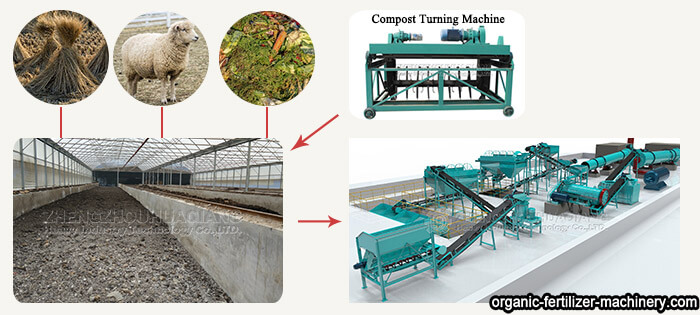
Raw material pretreatment serves as the foundation of the production process, aiming to create optimal conditions for fermentation. Personnel first collect and sort raw materials—including livestock manure, straw, and rice husks. A straw crusher is then used to pulverize coarse fibrous materials into pieces measuring 2–5 cm. Subsequently, a solid-liquid separator is employed to process high-moisture manure, reducing its solid moisture content to a range of 60%–65%. Following this, an automated batching system is utilized to precisely control the ratio of ingredients, ensuring that the main materials, auxiliary materials, and fermentation inoculants are thoroughly mixed. This step ensures that the carbon-to-nitrogen ratio remains stable within the range of 25:1 to 30:1, thereby providing sufficient nutrients to support microbial activity.
High-temperature aerobic fermentation constitutes the core stage of the production line and is critical for the harmless treatment of the waste materials. The mixed materials are transferred into fermentation tanks or formed into windrows (long piles). They are periodically turned and agitated using either trough type or crawler-type compost turning machines to replenish oxygen and regulate temperature, while a ventilation system works in tandem to control the overall fermentation environment. During the fermentation process, the temperature rises to between 55°C and 70°C and is maintained at this level for a specific duration; this effectively eliminates pathogens and insect eggs present in the raw materials. After 15 to 20 days of fermentation, the materials gradually mature and transform into stable humus, which then undergoes a curing (aging) phase to further enhance its stability.
Post-processing primarily involves refining the matured materials into a form that complies with commercial product standards. First, a vertical crusher is used to pulverize any agglomerated materials into a suitable particle size. Subsequently, functional microbial inoculants are added and thoroughly mixed into the material under low-temperature conditions to prevent the high heat from killing the beneficial microbial strains. Based on specific requirements, powdered raw materials are processed into 2–5 mm granules using a disc granulator or a new type organic fertilizer granulator. Subsequently, a drum dryer is employed to reduce the moisture content to below 20%. The material is then transferred to a cooler for a cooling treatment, lowering the fertilizer's temperature to ambient levels (approximately 25°C). This step prevents residual heat from causing the fertilizer to cake or become moldy, while simultaneously enhancing the hardness and stability of the granules. Upon completion of the cooling process, the material proceeds to a subsequent screening stage to ensure uniform product quality.
The packaging of the finished product constitutes the final step of the production process. After cooling and screening to remove impurities, the qualified fertilizer is fed into an automatic quantitative packaging machine. Following precise weighing, it is packaged into standard units—such as 25 kg or 50 kg bags—which are then sealed using a bag-stitching device before being transported to the finished goods warehouse for storage. This comprehensive bio-organic fertilizer production workflow effectively achieves the resource utilization of organic waste; it not only resolves environmental protection challenges but also yields high-quality fertilizers capable of improving soil structure and enhancing crop quality, thereby contributing to the advancement of green agriculture.
_800x600.jpg)
_800x600.jpg)
_800x600.jpg)
_800x600.jpg)