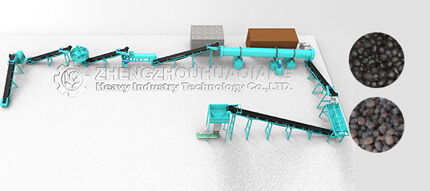
Bio-organic fertilizer, as a golden combination of organic matter and functional microorganisms, is an important support for promoting the green transformation of agriculture and improving soil. However, many people wonder why a granulation process is added to the production of bio-organic fertilizer.In fact, granulation is not an unnecessary process. Relying on a professional bio-organic fertilizer production line, it becomes a key measure to balance microbial activity, fertilizer efficacy, and practical application. It directly determines the quality and use value of bio-organic fertilizer and is a core means of solving its application pain points.
Granulation effectively protects the functional microbial community in bio-organic fertilizer, extending its fertilizer effect cycle. The core advantage of bio-organic fertilizer lies in its beneficial microorganisms, which can decompose soil nutrients and inhibit harmful bacteria. However, these microorganisms are sensitive to the environment and easily damaged by temperature, humidity, and external forces. In ungranulated powdered organic fertilizer, the microbial community is exposed, easily becoming inactive during transportation and storage, and quickly lost after application due to rainwater erosion and direct sunlight. After granulation, the granules form a protective layer that locks in the microbial community and organic matter, slowly releasing nutrients, allowing beneficial microorganisms to reproduce stably in the soil and fully exert their role in improving soil quality and yield.
Granulation addresses the pain points of powdered organic fertilizer application, improving ease of use. Powdered organic fertilizers are loose in texture, easily generating dust and clumping during transportation, and prone to moisture absorption and spoilage during storage, causing numerous inconveniences for farmers. More importantly, powdered fertilizers are easily dispersed by wind during application, resulting in uneven distribution and localized soil nutrient excess or deficiency, affecting crop growth. Granulated organic fertilizer particles are uniform and have good flowability, allowing for direct mechanized sowing. This not only saves labor but also ensures uniform fertilization, meeting the needs of large-scale agricultural production, while avoiding dust pollution and being more environmentally friendly.
Furthermore, granulation optimizes the structure of organic fertilizer, enhancing soil improvement effects. High-quality granulation processes create a porous structure within the particles, improving soil aeration and promoting soil aggregate formation after application. Continuous application of granulated bio-organic fertilizer can significantly increase soil porosity, enhance water and fertilizer retention capacity, and effectively alleviate soil compaction problems. Meanwhile, granular organic fertilizer decomposes at a moderate rate, continuously providing nutrients to crops while balancing rapid and long-term effects. This improves the quality of agricultural products and enables sustainable soil utilization.
In summary, granulation of bio-organic fertilizer is not only an optimization of the production process but also a necessary measure that balances fertilizer efficiency, convenience, and environmental friendliness. It allows the advantages of bio-organic fertilizer to be fully realized, adapting to the needs of modern agricultural development and providing strong support for the development of green and ecological agriculture.
_800x600.jpg)
_800x600.jpg)