In fertilizer production lines, the production process is not a one-size-fits-all approach. The core differences stem from variations in fertilizer types, raw material characteristics, and finished product requirements. Among the mainstream market categories—organic fertilizers, compound fertilizers, and water-soluble fertilizers—the production line processes show the most significant differences. While they share basic common steps, each also has its own core, unique steps, precisely tailored to the production needs of different fertilizers.
The common process for all three is relatively simple, including only three basic steps: raw material screening, mixing, and packaging. The main purpose is to remove impurities from the raw materials, ensure uniform composition, and facilitate storage and transportation. This forms the basic framework for all fertilizer production lines; the differences mainly lie in the intermediate core processing steps.
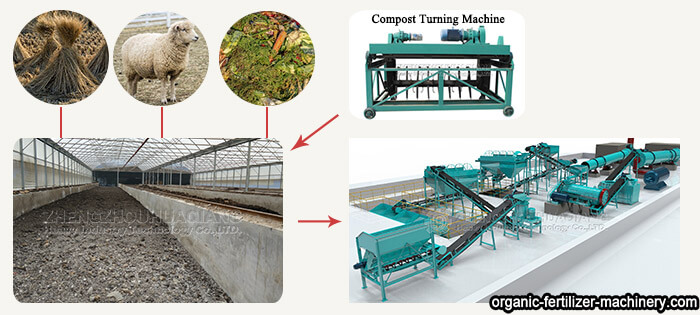
The core of the organic fertilizer production line is "composting and fermentation," which is its biggest difference from other fertilizer production lines. The raw materials are mostly animal manure, straw, and other organic materials. After screening, they are first crushed and then sent to fermentation tanks for 15-25 days of composting. High temperatures kill insect eggs and bacteria, and decompose harmful substances. After drying, cooling, and screening to remove uncomposted impurities, the product is packaged. The entire process focuses on "harmless treatment," preserving the natural nutrients in the raw materials.
The key to the compound fertilizer production line is "granulation and shaping." The raw materials mainly consist of various chemical fertilizers, such as urea, monoammonium phosphate, and potassium chloride. After screening and mixing, the materials are precisely proportioned according to the formula and then sent to a granulator (commonly using drum granulation or extrusion granulation) to form uniform granules. These granules are then dried, cooled, and screened. Unqualified granules are crushed and re-granulated, while qualified granules are packaged. The core of the process is "precise proportioning + granule formation," ensuring uniform nutrient distribution in each fertilizer granule.
The water-soluble fertilizer production line focuses on "solubility purification." The raw materials are mostly highly water-soluble chemical materials. After screening and mixing, granulation is not required. The materials are directly crushed, dissolved, and purified to remove insoluble impurities, ensuring that the finished product dissolves quickly in water. This is followed by concentration, spray drying (for powdered water-soluble fertilizers) or stirring and homogenization (for liquid water-soluble fertilizers), and finally quantitative packaging. The process is relatively simple, with the core focus on "improving solubility," adapting to modern agricultural fertilization methods such as drip irrigation and sprinkler irrigation.
In summary, the differences between different fertilizer production lines are essentially determined by the characteristics of the raw materials and the intended use of the finished product. Organic fertilizers emphasize fermentation, compound fertilizers emphasize granulation, and water-soluble fertilizers emphasize purification. Understanding these core differences allows for quick differentiation between various production lines and a more accurate understanding of the production logic of different fertilizers.
_800x600.jpg)
_800x600.jpg)